

AI Agent for TYPO3: AI Foundation 2.0 Writes Only When You Say So
AI


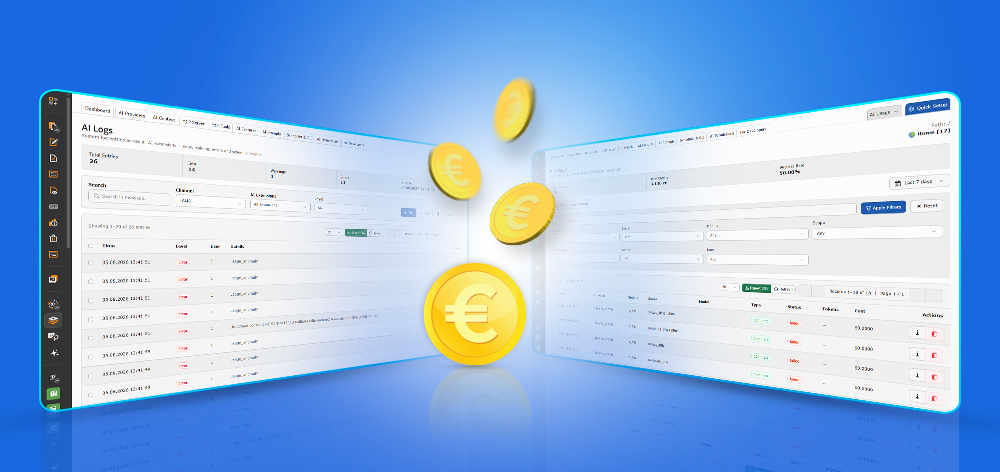
TYPO3 AI cost tracking means logging every AI request your backend makes, by user, model, and token, then turning that into a budget and a dashboard you can actually read. Skip it, and AI spend just disappears into the hosting bill until an invoice shows up with no explanation attached. That is how you see what AI really costs.
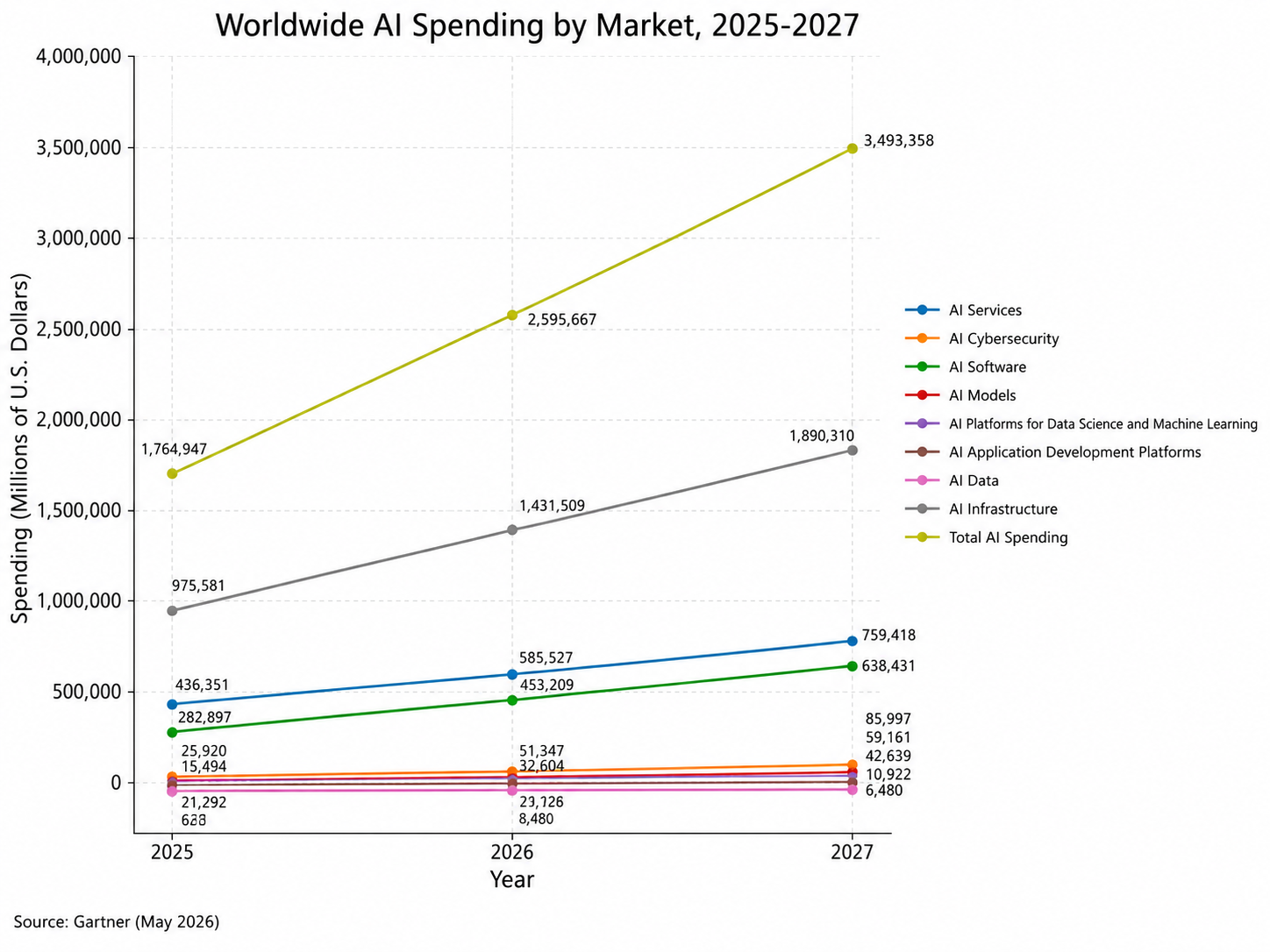
That gap isn't theoretical. Worldwide AI spending is set to hit roughly $2.59 trillion in 2026, up 47 percent year over year, according to Gartner's May 2026 forecast. Most of that money moves through ordinary backend tools, and almost none of it gets tracked per editor, per extension, or per page.
AI adoption on a TYPO3 site usually starts small: an editor uses AI to tighten a paragraph, a developer wires up a translation script, someone automates alt-text generation. Nobody plans for AI cost tracking at that stage. The trouble shows up later, once three or four AI workflows are running at once and tracking down what any of it costs takes real digging.
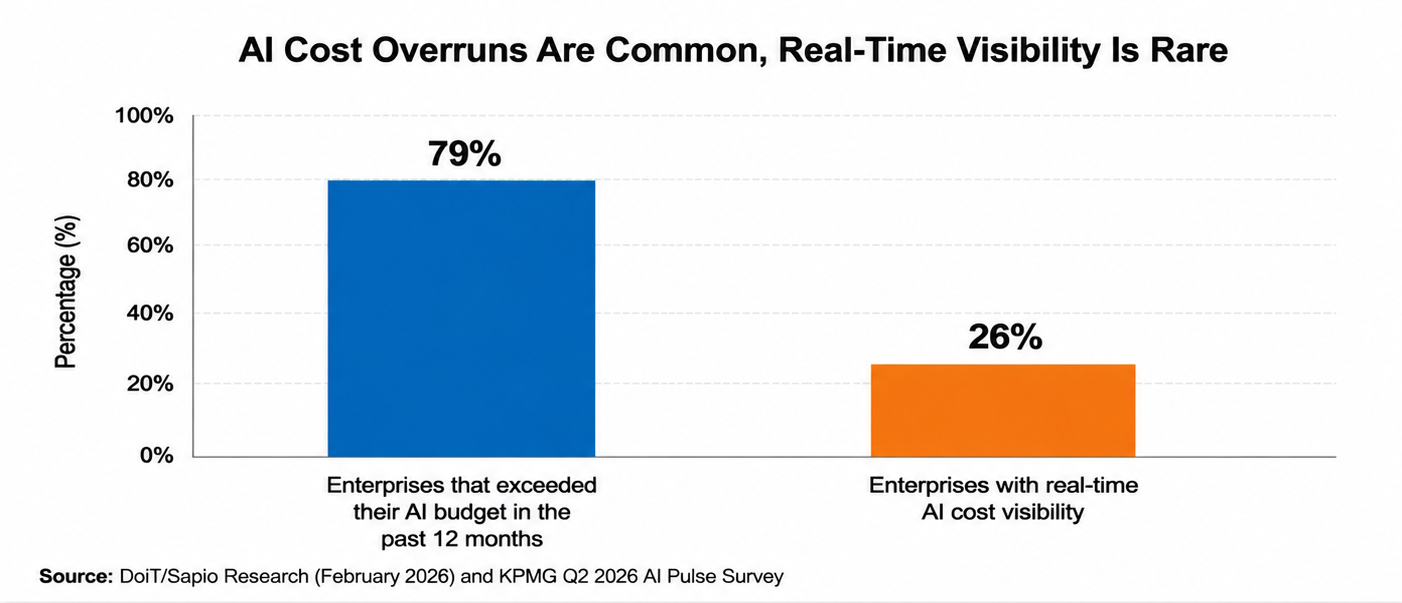
In February 2026, Sapio Research surveyed 500 finance leaders for DoiT and found 79 percent of enterprises had overrun their AI budget in the past year. A separate KPMG Q2 2026 AI Pulse survey of 204 U.S. business leaders put real-time cost visibility at just 26 percent.
TYPO3 sites follow the same industry-wide pattern. Once AI spans content, translation, SEO, and accessibility, most teams can no longer answer three basic questions: which AI feature is consuming the most budget, which users or extensions are generating the cost, and whether any of it lines up with what the business actually needs.
The teams that set up central tracking early are the ones who can answer finance's questions, instead of scrambling for the numbers after the fact.
AI cost tracking is more than simply connecting an API key. An API key only enables access to an AI provider. It does not show who used the service, what resources were consumed, or whether spending stayed within the planned budget.
A proper AI cost tracking system needs:
AI providers use different pricing models based on tokens, models, and usage volume. TYPO3 environments often connect with multiple AI providers, making cost comparison difficult without a unified system.
Centralized AI cost tracking brings provider usage into one view, helping teams understand total AI consumption, compare spending patterns, and manage AI investments more effectively.
AI cost visibility usually breaks down as AI adoption grows faster than tracking systems. TYPO3 teams commonly face three challenges:
Visibility breaks down three ways, and TYPO3 sites tend to hit all three eventually.
Editors and developers sign up for tools outside procurement, and Flexera's 2026 State of ITAM Report found only 31 percent of organizations have accurate visibility into their AI software at all. KPMG's parallel Global AI Pulse survey of 2,145 leaders across 20 markets found 42 percent have only partial visibility into spend, not full and not none, just enough to be dangerous.
Five extensions, five separate provider keys, and no single log that captures the whole picture. Two extensions calling the same provider for overlapping work, an AI search extension and a content assistant both hitting the same model for similar tasks, is a common way duplicate spend slips through unnoticed.
A shared API key can't tell you if one especially enthusiastic content editor is running ten times the AI calls of everyone else combined. That gets expensive fast once bulk page operations get involved, and administrators are left guessing which user, extension, or workflow is actually driving the number on the invoice.
A complete AI cost tracking system needs more than a simple usage counter. It should combine visibility, control, and accountability.
Without these controls, AI tracking only reports past spending instead of helping teams manage future costs.
AI Foundation for TYPO3 is the closest native answer to this problem inside TYPO3 itself. Instead of bolting on a separate analytics tool, it builds cost tracking straight into the backend module that already manages AI providers.
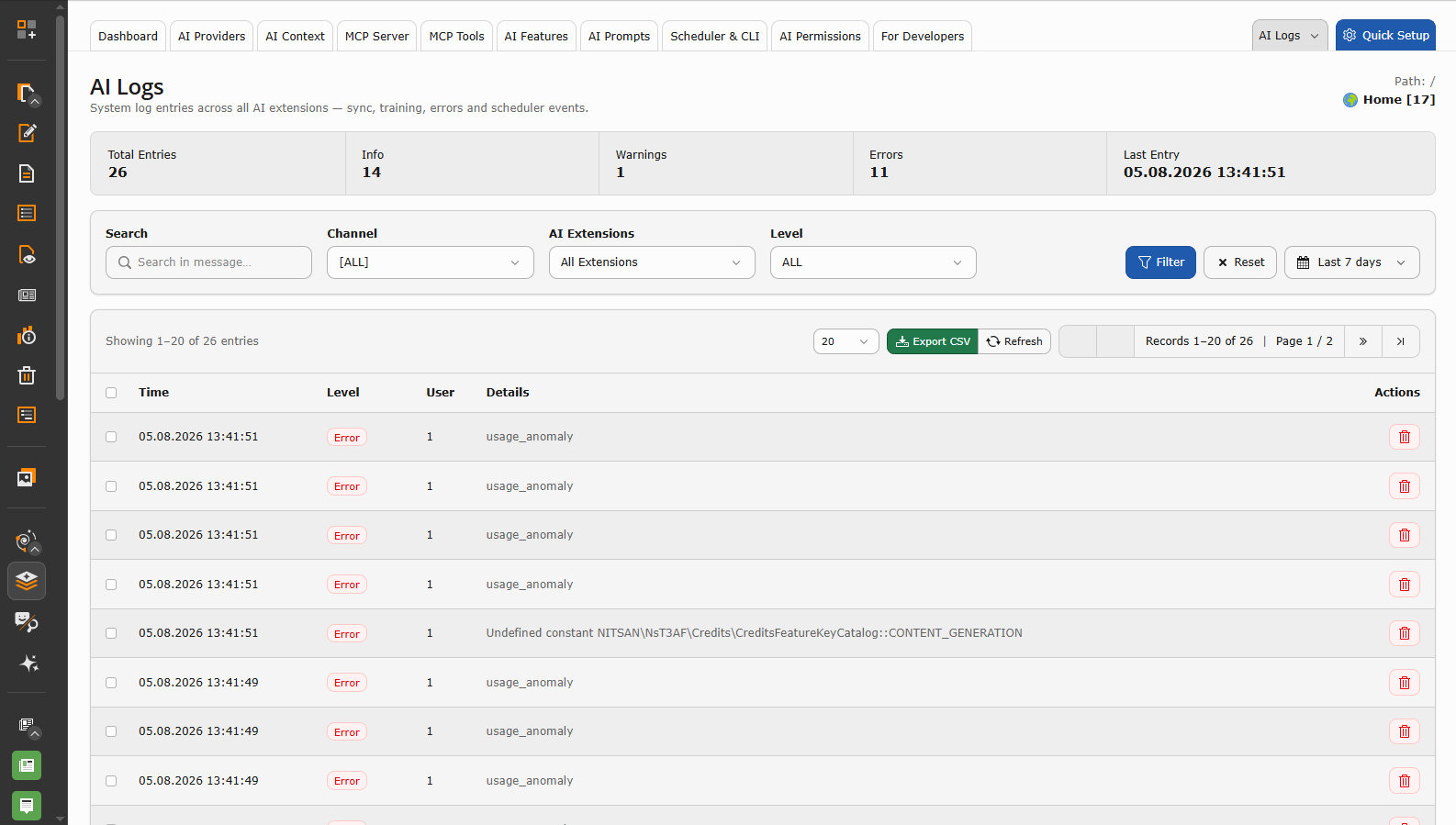
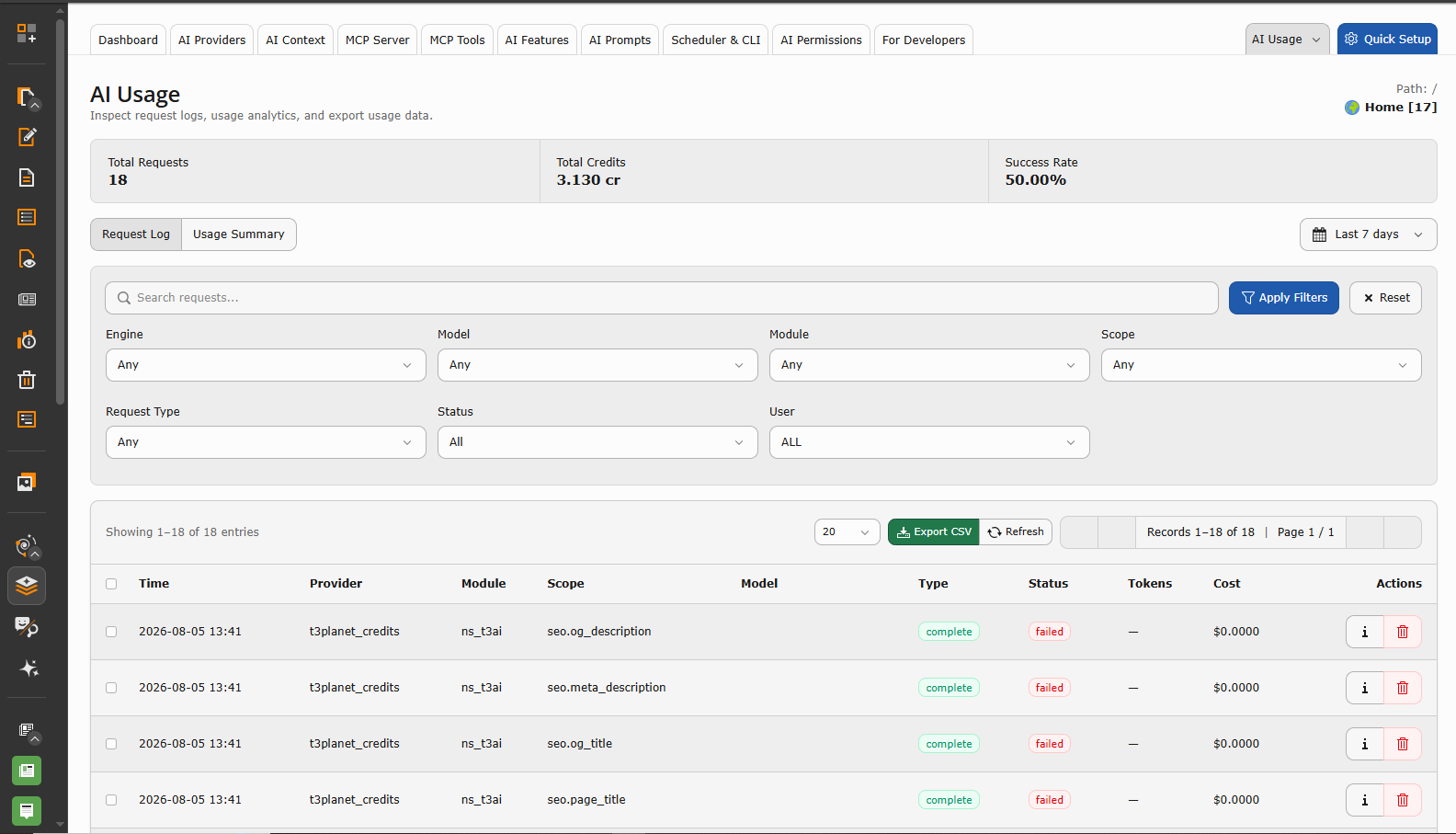
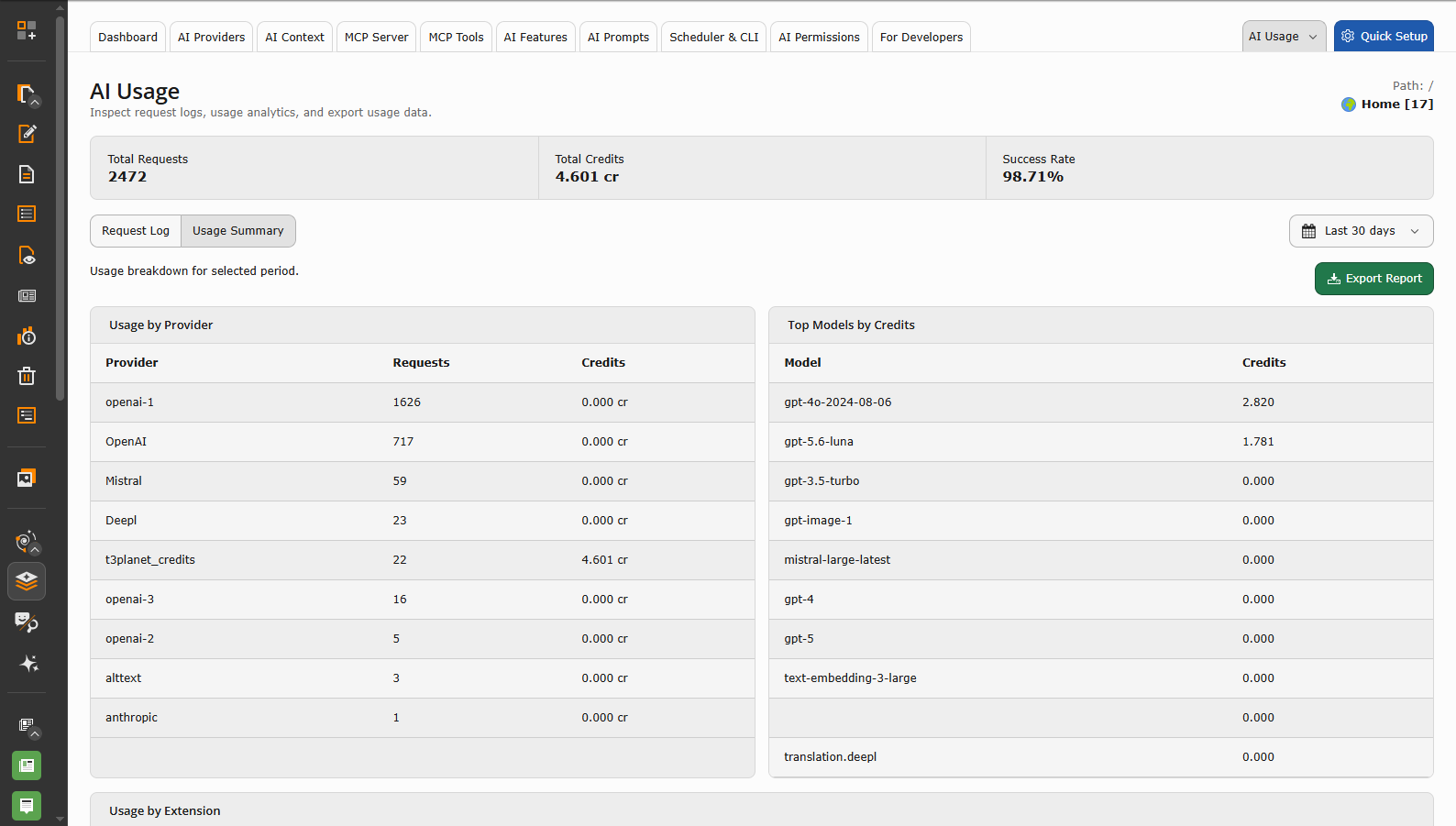
Every request gets recorded: model, tokens, cost, duration, and the user who triggered it. That rolls into 30-day summaries by provider, module, model, and user, with CSV export and 90-day retention. Administrators get alerts for invalid API keys and quota limits before either one turns into a support ticket.
Monthly caps sit at the provider and extension level, with on/off toggles, so one integration can be capped independently of everything else running on the site.
Multi-page AI actions, like meta tag generation across a whole page tree, show a live cost estimate before you run them. Not after, when it's too late to change your mind.
It's open source under GPL-2.0. The source is on GitHub, it's also listed on TER, setup steps live in the official T3AF documentation, and it runs entirely on your own infrastructure with your own provider keys.
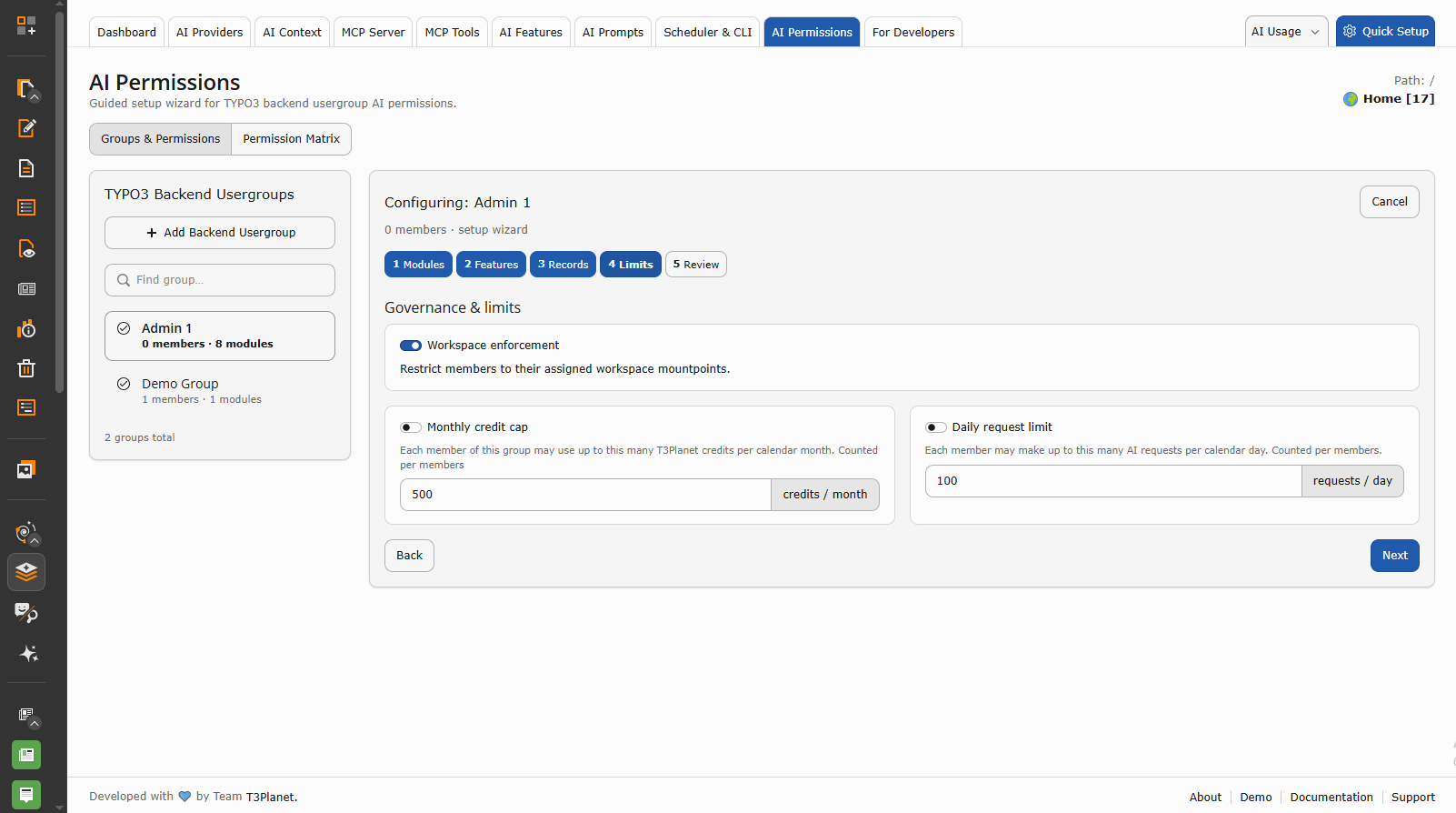
AI cost control works best when budgets are connected to user roles, not just tracked as a total number. AI Foundation for TYPO3 uses TYPO3’s existing backend user groups to create a structured AI governance model.
| Role | What They Get | How Overspending Is Prevented |
| Editor | A predefined AI usage limit set by administrators | Requests stop automatically when the assigned limit is reached |
| Integrator | Dedicated AI providers and budgets for individual client projects | AI costs stay separated, making project-level tracking and attribution easier |
| Administrator | Full control over quotas, permissions, usage rules, and audit logs | Complete visibility and control across users, modules, projects, and extensions |
Editors can use AI within the limits defined for their role, while administrators maintain control over overall spending. Integrators managing multiple client projects can configure separate budgets and provider settings to keep costs organized from the beginning.
Administrators get a complete overview of AI activity through role-based permissions, usage limits, and audit trails. With one centralized governance layer, TYPO3 teams can manage AI access consistently across all connected workflows and extensions.

Cost tracking and compliance end up needing the same infrastructure, which is convenient if you already built one of them. From 2 August 2026, Article 50 of the EU AI Act requires organizations deploying certain AI systems to disclose AI interactions and label AI-generated content. Penalties reach €15 million or 3 percent of global turnover for getting it wrong.
A detailed audit log already needs to capture which model was used, who triggered the request, when it happened, and what it produced, which happens to be most of what Article 50 expects on traceability too. Cost tracking and legal compliance are technically two different obligations, but the record that satisfies one gets you most of the way to the other.
T3AF's personal workspace model reinforces this: AI output sits in draft until a person reviews and publishes it, which is exactly the human-in-the-loop pattern regulators want. None of this replaces an actual legal review of your specific setup.
Many teams still manage AI costs through manual spreadsheets or traditional analytics tools. These approaches often struggle when multiple AI providers, extensions, and users are involved.
| Approach | Real-Time Data | User-Level Tracking | Audit Trail | Setup Effort |
| Spreadsheet from invoices | No, reporting is delayed | Limited | Manual and easy to overlook | Low initially, but requires ongoing manual work |
| Generic analytics tool | Partial | Depends on the integration | Usually not designed specifically for AI requests | Medium, often requires customization |
| Native TYPO3 module (e.g., AI Foundation for TYPO3) | Per-request tracking | Tracks usage by backend user | Built-in AI usage logs | Low, typically configured once |
A native AI cost tracking solution provides two major advantages: it can identify overspending while it is happening and connect usage directly to specific users, extensions, and workflows.
AI is becoming a regular part of TYPO3 workflows, from content creation and translations to accessibility and automation. As usage expands, teams need more than separate API keys or monthly invoices to understand their AI spending.
A reliable AI cost tracking approach starts with three essentials: per-request visibility, budget controls, and role-based access management. AI Foundation for TYPO3 brings these capabilities directly into the TYPO3 backend, helping teams monitor usage, control expenses, and manage AI workflows with confidence.
By setting up cost tracking early, TYPO3 organizations can scale AI adoption without losing visibility, accountability, or control.
AI cost tracking means logging every AI request from the backend, by model, token count, and user, then rolling it into budgets and dashboards. It turns AI spend from a surprise invoice line into a number you can actually see and control.
The reliable way is a native module that logs every request as it happens. AI Foundation for TYPO3 does this through its AI Usage & Logs dashboard, recording model, tokens, cost, and user for every AI action across connected extensions.
Yes, as long as the tracking system logs the user and module with every request. T3AF's dashboard breaks usage down by provider, module, model, and backend user, so one editor's token usage doesn't require cross-referencing three separate systems.
Yes. Once a provider's connected, every AI request across T3AF and its extensions, including the AI chatbot for TYPO3 and the AI accessibility extension, gets logged automatically: model, token count, cost, duration.
Shadow AI is AI usage that happens outside centralized IT visibility, like an editor's personal subscription used for work. Flexera's 2026 ITAM Report found only 31 percent of organizations have accurate AI software visibility, so shadow AI spend usually just doesn't get tracked.
Tie budgets to TYPO3's existing backend usergroups and set a quota once per role. T3AF's permission wizard applies per-group credit limits and module access, so editors, integrators, and administrators each stay inside a ceiling without individual setup.
Partly. Article 50, effective 2 August 2026, requires disclosure and audit trails for certain AI systems. A cost tracking log that already records model, user, and timestamp covers a lot of that ground, though compliance still needs its own separate review.
A lot. A February 2026 Sapio Research survey of 500 finance leaders, commissioned by DoiT, found 79 percent of enterprises had overrun their AI budget in the prior year, with the most mature FinOps teams reporting the highest average overspend at 30.9 percent.
Jürgen Pietschmann
AI Consultant for TYPO3Jürgen Pietschmann is a T3Planet Product Consultant at T3Planet Shop. He specialises in integrating AI into editorial workflows – from intelligent content creation and automated SEO to AI-powered search and chatbot solutions for TYPO3 sites. As a technical consultant for T3Planet AI Universe, he works closely with agencies and editorial teams on practical TYPO3 implementations. Jürgen has been writing the This Month in TYPO3 series since December 2025 and has spoken at T3CON25 and TYPO3 Developer Days 2026 (T3DD26), where he co-presented Content Editing Unlocked.
More From Author