Artificial intelligence has moved from being a trend to becoming part of everyday tools in web development. Since the TYPO3 Conference 2023, the topic of AI has received more attention in the TYPO3 community, showing how strongly it is shaping the future of content management.
For modern websites, AI is no longer just about writing text. It helps with translations, search, personalization, and even accessibility checks. These improvements make content management faster and more reliable.
TYPO3, as an open-source CMS, is well positioned to take part in this change. With community-driven extensions and integration options, it is already possible to use AI in practical TYPO3 projects today. This development opens new opportunities for both developers and editors.
What is TYPO3 AI?
TYPO3 AI describes the integration of artificial intelligence into the TYPO3 CMS. Instead of being a single tool, it is a growing set of extensions, APIs, and workflows that allow TYPO3 to connect with AI services. The main goal is to support editors, developers, and companies by making content management smarter, faster, and more efficient.
How TYPO3 AI Integrates into the CMS
TYPO3 AI works by connecting TYPO3 with external AI platforms or by using TYPO3-specific extensions that bring AI functionality directly into the backend.
Extensions from the TYPO3 Extension Repository (TER): Popular packages like ai_helper, chatgpt_integration, or ai_seo add AI-based content generation, TYPO3 SEO optimization, or translation features.
API Connections: TYPO3 can connect to services like OpenAI, DeepL, or Google Vision via API keys. This makes it possible to generate text, translate content, or even analyze images directly within TYPO3.
Backend Integration: The AI functions are available in the editor interface. For example, editors can click a button to generate text suggestions, get metadata proposals, or automate translations without leaving TYPO3.
Benefits of TYPO3 AI
AI in TYPO3 brings practical advantages for different roles:
Task Automation: Routine work such as generating meta descriptions, writing alt texts, or summarizing content can be automated.
Efficiency Gains: Content teams save time on repetitive tasks, which shortens publishing cycles. Developers also benefit by automating testing or content workflows.
SEO Improvements: AI can suggest keywords, optimize content structure, or adjust titles and descriptions to improve visibility on search engines.
Content Personalization: Websites can adapt content to different user groups or markets in real time, increasing relevance and user engagement.
TYPO3 AI as a Co-Pilot
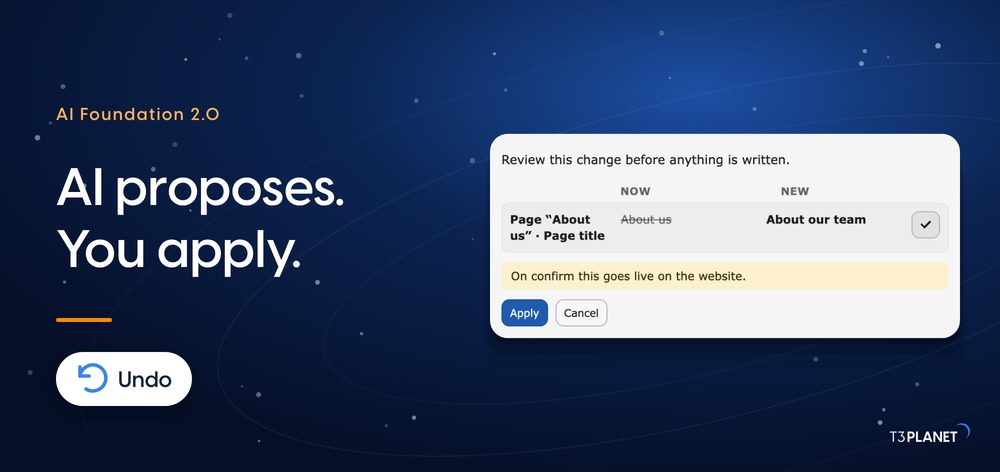
A key idea behind TYPO3 AI is the co-pilot principle. AI is not designed to replace human work but to assist it:
Editors get suggestions for headlines, page texts, or metadata, but they can review and adjust them.
Developers can use AI for code snippets or documentation, while still keeping control over the implementation.
Companies can standardize workflows with AI, but decisions remain with their teams.
This ensures that TYPO3 users keep full control of quality and strategy, while AI reduces manual workload and provides helpful insights.
How TYPO3 AI is Transforming TYPO3 CMS
Artificial intelligence is changing the way content is managed in TYPO3. Instead of relying only on manual work, editors and developers can now use AI-powered tools that simplify processes, reduce repetitive tasks, and improve the quality of content. TYPO3 AI is not replacing people, but supporting them in their daily work.
Key Changes in Content Management
Smarter Content Creation TYPO3 AI helps editors generate draft texts, headlines, or summaries with a single click. This reduces the time needed to start writing and ensures more consistent quality across pages.
Automated Metadata and SEO AI can create meta titles, descriptions, and alt texts automatically. These small but important elements are often missed in manual work. With automation, TYPO3 sites can improve search engine visibility and accessibility.
Multilingual Management TYPO3 has always been strong in multilingual publishing. With AI, translations are faster and more natural, which makes it easier to manage large websites in multiple countries.
Media Support Instead of creating images or graphics from scratch, editors can use AI to generate visuals or automatically describe media files for accessibility.
Streamlining Workflows and Improving Efficiency
Faster Publishing: Repetitive steps like adding tags, checking readability, or creating summaries can be automated.
Consistent Quality: AI provides suggestions that follow the same rules, reducing mistakes and ensuring a uniform style.
Reduced Workload: Teams can focus on strategy and creativity, while AI takes care of routine tasks.
Better Collaboration: Developers, editors, and marketers all use the same AI tools within TYPO3, making workflows smoother.
AI Content Creation with TYPO3
Content creation is one of the most time-consuming parts of managing a website. TYPO3 AI reduces this effort by supporting editors, marketers, and developers in generating text that is not only readable but also aligned with search engine requirements.
AI-Generated Content in TYPO3
With TYPO3 AI, different types of content can be created directly in the backend:
Blog posts: Drafts, headlines, or summaries can be generated instantly.
Landing pages: AI suggests clear structures and key points, helping teams build pages faster.
Product descriptions: Texts for e-commerce or catalog pages can be generated in bulk while maintaining consistency.
SEO Optimization with AI
AI does not stop at writing content. It also ensures that the text is optimized for search engines:
Keyword suggestions: AI identifies relevant search terms for better visibility.
Content structure: Headlines, paragraphs, and lists are organized in a logical way.
Engagement focus: AI suggests phrases that encourage readers to interact with the content.
Examples of AI in Action
TYPO3 AI is already being used in different real-life scenarios:
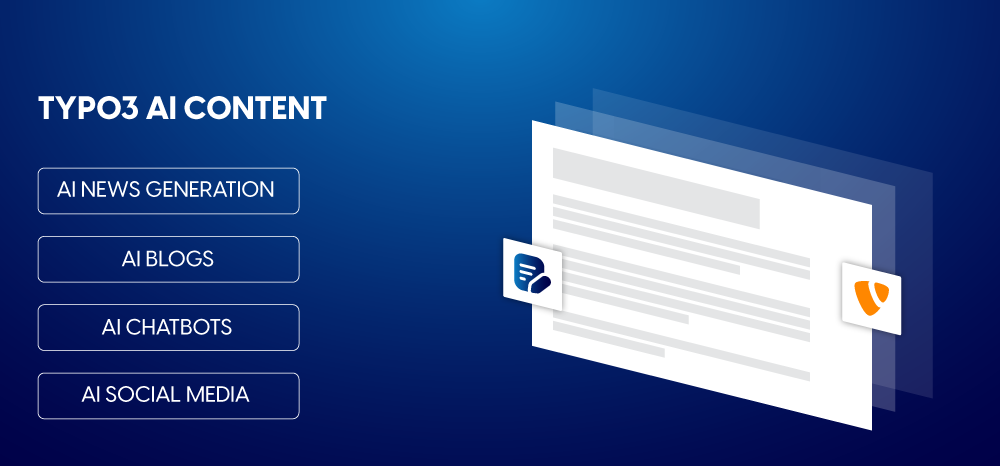
News articles: AI creates short teasers, full texts, or summaries to publish updates quickly.
Blog posts: From idea to draft, AI assists at every stage.
Chatbots: Content can be repurposed into Q&A for TYPO3-based AI chat assistants.
Automated social media posts: Website content can be turned into posts for different platforms with minimal effort.
AI Translation with TYPO3
Managing a multilingual TYPO3 website is often complex. Editors and companies need to create and maintain content in several languages, which can quickly become time-consuming and inconsistent if done manually. TYPO3 AI offers a practical solution by automating translation tasks directly within the CMS.
Challenges of Multilingual TYPO3 Websites
High effort: Translating pages, products, and news articles one by one requires significant resources.
Inconsistency: Manual translations may lead to style or terminology differences across languages.
Time pressure: Updates in one language often lag in others, creating delays for international users.
TYPO3 AI for Automated Translations
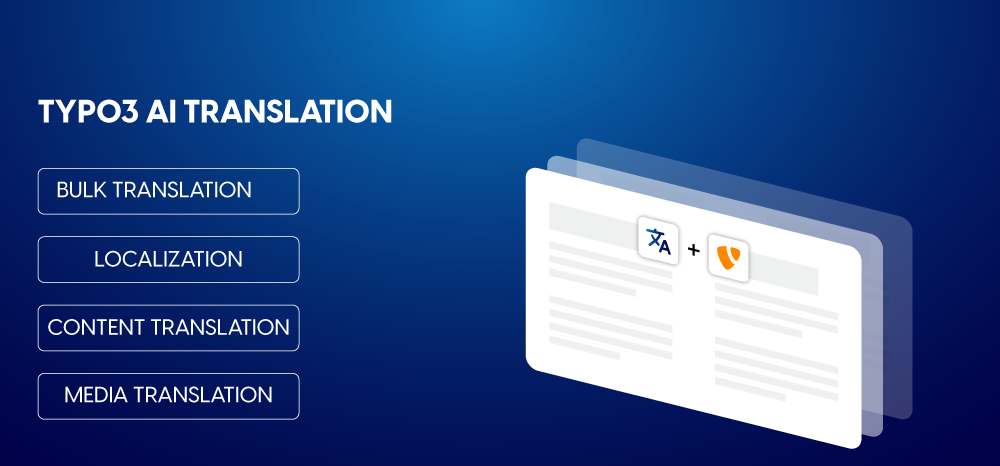
AI integrates into the TYPO3 backend to handle translations automatically. Instead of copying and pasting content into external tools, editors can translate directly inside TYPO3. TYPO3 AI learns from existing content and improves over time, delivering better quality with less manual review.
Benefits of AI Translation
Time-saving: Large amounts of content can be translated within minutes.
Accuracy: AI uses context-based translation to reduce mistakes.
Consistency: Terminology, product names, and brand tone stay uniform across all languages.
TYPO3 AI Extensions for Translation
Several TYPO3 AI extensions already support automated translation:
TYPO3 AI Localization:TYPO3 AI Localization handles full-page translations and adapts content to regional differences.
XLIFF AI tools: Translate structured TYPO3 files (like XLIFF) for professional multilingual workflows.
Third-party AI integrations: Allow direct connection to AI models for advanced translation features.
AI SEO with TYPO3
Search Engine Optimization (SEO) is a critical part of every TYPO3 project, but managing it manually can be time-consuming. TYPO3 AI helps by automating many SEO tasks directly within the CMS, giving editors and marketers more time to focus on content quality.
Automating SEO Tasks with TYPO3 AI
TYPO3 AI integrates smart tools into the backend that can:
Analyze website content and highlight missing elements like meta tags or headings.
Suggest keywords and improve keyword placement across pages.
Rephrase content for better readability and engagement.
Generate Schema.org markup, helping search engines understand the structure of the website.
Run automated SEO audits that detect broken links, missing alt texts, or slow pages.
Benefits of AI SEO
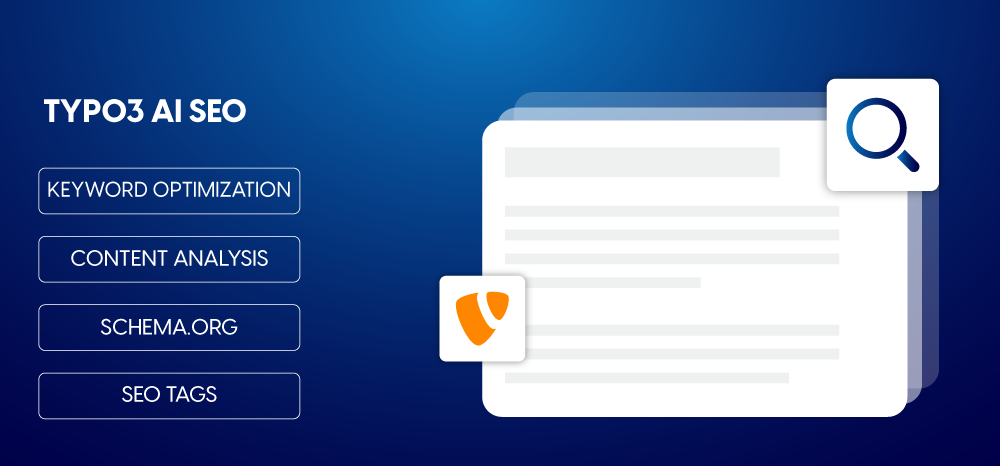
Keyword Optimization: AI tools identify high-value keywords and suggest where they should appear.
Content Analysis & Rephrasing: TYPO3 AI can expand, shorten, or rewrite content to make it clearer and more SEO-friendly.
Automated SEO Audits: Routine checks that normally take hours can be done in minutes.
Schema.org Markup Creation: AI generates structured data for products, articles, and events, improving visibility in search results.
AI SEO in Numbers
Recent industry data shows the real impact of AI in SEO:
88% of marketers who invested in SEO plan to maintain or increase spending on AI tools.
Companies using AI for SEO report a 6–10% revenue boost.
86% of users believe AI can deliver more effective SEO results.
75% of marketers already use AI tools regularly in their SEO workflows.
About 67% of small businesses are applying AI for content and keyword improvements.
With TYPO3 AI, these global SEO trends are now directly accessible inside the CMS, making optimization faster, smarter, and more consistent.
AI Media Generation with TYPO3
Creating high-quality media like images, videos, and audio has always required time, effort, and sometimes external tools. For TYPO3 editors, this often means switching between different platforms, hiring designers, or spending hours fine-tuning visuals. This slows down content production and makes workflows less efficient.
The Problem: Manual Media Creation
Designing graphics, editing videos, or recording audio can take hours.
Teams often depend on external software or specialists.
Updates or changes to visuals delay publishing new content.
The Solution: TYPO3 AI Media Tools
With TYPO3 AI, media generation can be done directly inside the CMS:
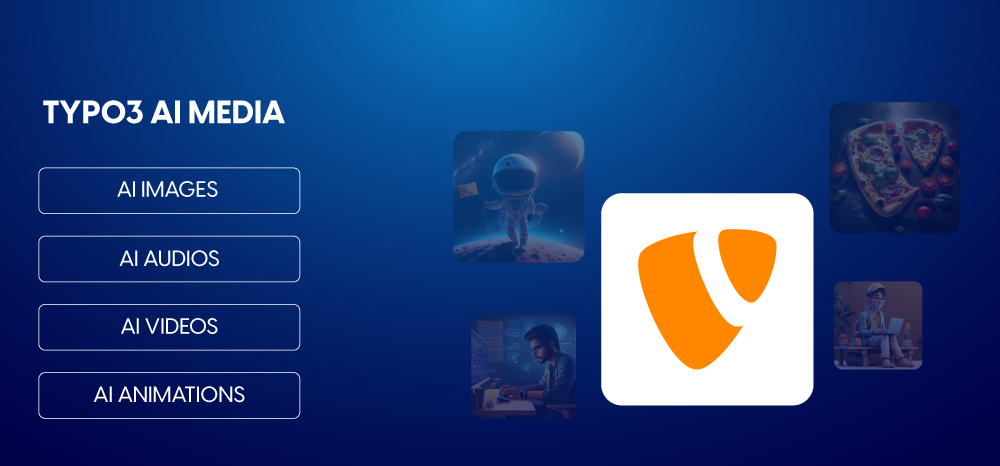
AI Images: Generate illustrations, product images, or banners within TYPO3.
AI Videos: Create simple explainer or promotional videos with text-to-video AI tools.
AI Audio: Produce background music, podcasts, or even voiceovers using text-to-speech AI.
This removes the need for separate design tools and speeds up the publishing process.
Benefits of AI Media in TYPO3
Faster Workflows: Content teams can generate visuals and audio in minutes, not days.
Improved User Experience (UX): Websites get more engaging and diverse media elements.
Consistency: AI ensures brand colors, styles, and formats stay uniform across all media.
Accessibility: AI can generate alternative text and captions for media, helping with WCAG compliance.
With TYPO3 AI media generation, editors and developers no longer need to juggle multiple tools. Everything happens inside the TYPO3 ecosystem, saving both time and cost while delivering professional-quality results.
AI Meets TYPO3 Accessibility
Accessibility is no longer an optional feature for websites. Governments, businesses, and organizations must follow standards like WCAG, ADA, and BITV to provide barrier-free websites and digital experiences. TYPO3 has always offered strong accessibility features, and with AI, this becomes even more powerful.
The Role of AI in TYPO3 Accessibility
AI technologies simplify the process of building accessible websites. Instead of relying only on manual work, TYPO3 AI automates many tasks, reducing errors and saving time for TYPO3 editors and TYPO3 developers.
Key AI Features for Accessibility in TYPO3
Metadata Optimization: AI can automatically generate and improve page titles, descriptions, and alt text. This helps both screen readers and SEO.
AI-Generated Media Descriptions: Images, videos, and graphics can have AI-created descriptions, ensuring visually impaired users receive the right context.
AI-Powered Captions & Subtitles: Video and audio content can be transcribed and captioned by AI, improving accessibility for users with hearing impairments.
AI Voiceovers & Text-to-Speech: Content can be converted into natural-sounding speech, offering an alternative way for users to consume information.
Voice Search & NLP Integration: With AI-driven natural language processing (NLP), TYPO3 websites can support voice commands, making navigation easier for users with mobility challenges.
TYPO3 AI Extensions for Accessibility
Solutions like T3AI Accessibility Tools integrate directly into TYPO3. They help editors automate tasks such as alt text generation, voice accessibility, and AI-driven content checks. This ensures websites stay compliant with international accessibility standards while reducing workload.
By combining TYPO3’s accessibility foundation with AI, businesses can create websites that are inclusive, compliant, and future-ready, while saving significant time in the editing process.
AI Meets TYPO3 Support
Customer support is often a challenge for businesses running TYPO3 websites. Teams spend a lot of time answering repetitive questions such as login issues, content updates, or product details. Support availability is also limited, especially outside of working hours.
The Problem
Repetitive FAQs drain team productivity.
Users expect instant responses, but human support is not available 24/7.
Scaling support for multilingual TYPO3 websites is difficult and costly.
The Solution: TYPO3 AI Chatbot (T3AC Extension)
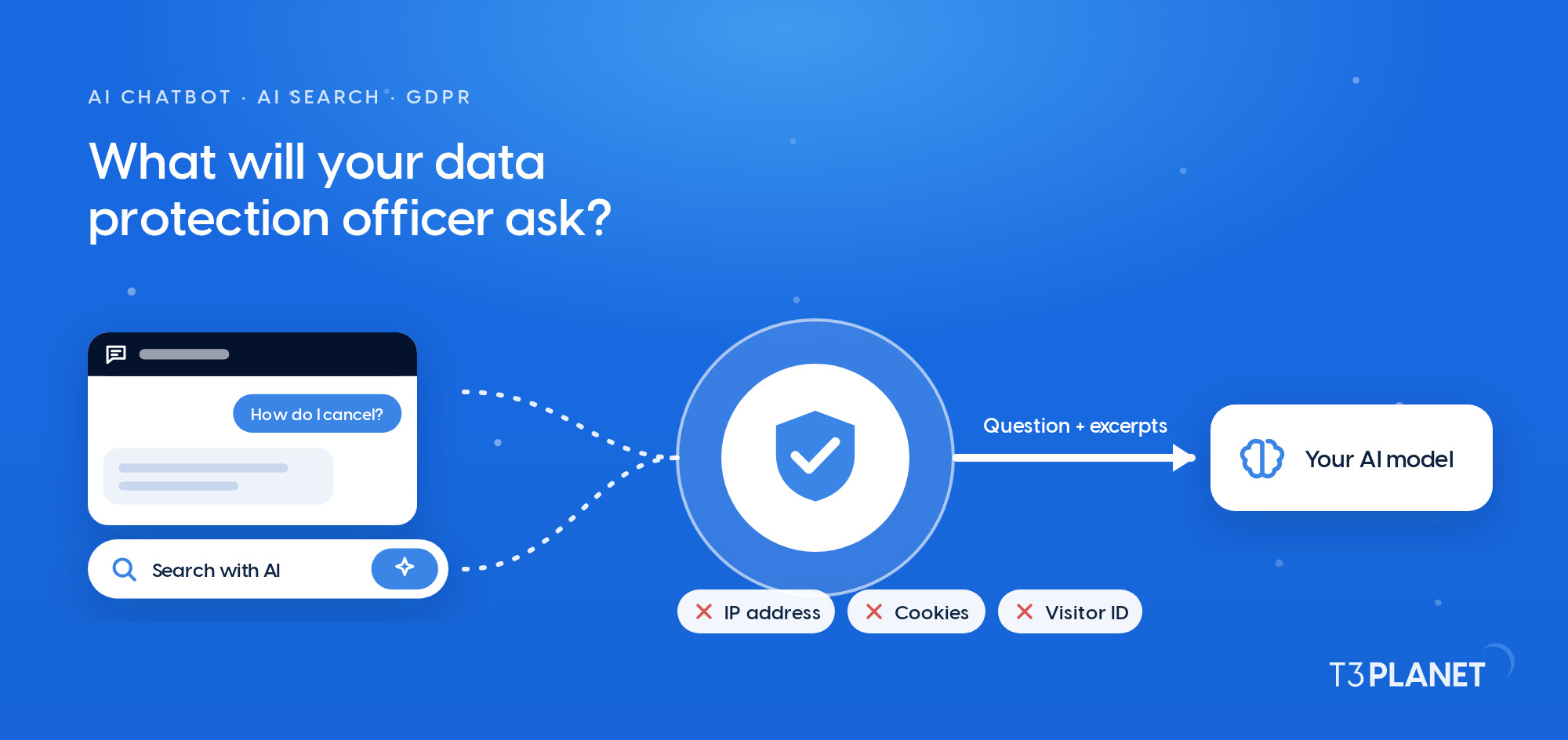
The T3AC AI Chatbot extension brings an intelligent assistant directly into TYPO3. It can be trained on your site content (FAQs, blogs, product descriptions) and provide real-time answers to visitors. Unlike third-party bots, it runs natively inside TYPO3, ensuring data privacy and GDPR compliance.
Key Benefits
24/7 Support Visitors get instant help anytime, even outside office hours.
Content-Aware Responses The chatbot learns from TYPO3 content such as FAQs, articles, and product pages to give accurate answers.
Multilingual Support AI can handle queries in multiple languages, ideal for global businesses.
Conversion Boosting By guiding visitors to the right page or product quickly, the chatbot helps increase leads and sales.
With TYPO3 AI Chatbots, support moves from being reactive to proactive and scalable, giving both users and businesses a better experience.
TYPO3 AI Universe: Smarter AI Solutions for Your Website
Key TYPO3 AI Extensions
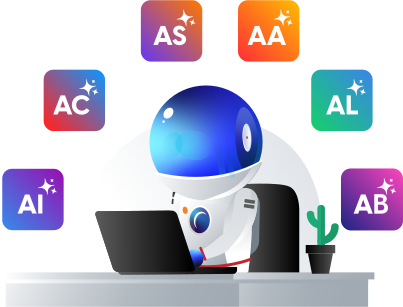
T3AI – AI Assistant Generate SEO-friendly blogs, landing pages, and product descriptions directly inside the TYPO3 backend.
T3AC – AI Chatbot Offer real-time, 24/7 support with an AI-driven chatbot that learns from TYPO3 content and complies with GDPR.
T3AA – AI Accessibility Automate alt text, metadata, captions, and voiceovers to meet WCAG, ADA, and BITV accessibility standards.
T3AS – AI Search Provide faster and more relevant search results using AI-powered query understanding.
T3AL – AI Localization Simplify multilingual website management with AI-driven translation and localization of TYPO3 content.
With the TYPO3 AI Universe, developers and businesses gain AI-powered solutions not just for content and user experience, but also for development itself, making TYPO3 more future-ready than ever.
Future Potential of TYPO3 AI
The development of TYPO3 AI is still in its early stages, but the potential is already clear. In the coming years, we can expect features that make content management more intelligent, faster, and more user-focused.
Real-time content personalization TYPO3 AI could adapt websites to each visitor automatically, showing relevant products, news, or services in real time.
Voice search integration With more users searching by voice, TYPO3 AI may integrate natural language processing (NLP) to deliver accurate results for spoken queries.
Smarter AI-powered chatbots Future TYPO3 chatbots will not only answer FAQs but also guide users through complex processes like bookings, e-commerce, or form submissions.
Continuous learning & improvement TYPO3 AI systems can improve themselves by learning from user interactions, content performance, and SEO results, leading to smarter websites over time.
Conclusion
TYPO3 AI is opening new possibilities for content management, SEO, translation, accessibility, and support.
Now is a good time for organizations to start adopting TYPO3 AI in their workflows and test how it can support editors, marketers, and developers.
This article is part of an upcoming TYPO3 AI series where we will continue to share practical use cases, tools, and tips to make AI a natural part of TYPO3 projects.
Frequently Asked Questions
TYPO3 AI is an advanced technology that uses open-source AI tools to enhance content creation, translation, media generation, and SEO optimization. It integrates artificial intelligence into TYPO3 CMS to make tasks faster and easier.
TYPO3 AI is useful for editors, marketers, website owners, and developers. You do not need deep technical skills to use its basic features.
TYPO3 AI improves SEO by generating optimized content, analyzing keywords, and ensuring all necessary SEO elements like meta tags and descriptions are included.
Yes, TYPO3 AI allows you to customize and fine-tune AI-generated content to meet your specific needs and preferences.
By automating many tasks like content creation, translation, and media generation, TYPO3 AI helps improve workflow efficiency, allowing you to focus on other important aspects of your website.
Yes. It can translate content into different languages, which is helpful for websites with international audiences.
Want to Customize Your AI Universe Product?
Discover AI-powered TYPO3 solutions from T3Planet Shop and customize them for your project needs.
Jürgen Pietschmann is a T3Planet Product Consultant at T3Planet Shop. He specialises in integrating AI into editorial workflows – from intelligent content creation and automated SEO to AI-powered search and chatbot solutions for TYPO3 sites. As a technical consultant for T3Planet AI Universe, he works closely with agencies and editorial teams on practical TYPO3 implementations. Jürgen has been writing the This Month in TYPO3 series since December 2025 and has spoken at T3CON25 and TYPO3 Developer Days 2026 (T3DD26), where he co-presented Content Editing Unlocked.





Jürgen Pietschmann
AI Consultant for TYPO3Jürgen Pietschmann is a T3Planet Product Consultant at T3Planet Shop. He specialises in integrating AI into editorial workflows – from intelligent content creation and automated SEO to AI-powered search and chatbot solutions for TYPO3 sites. As a technical consultant for T3Planet AI Universe, he works closely with agencies and editorial teams on practical TYPO3 implementations. Jürgen has been writing the This Month in TYPO3 series since December 2025 and has spoken at T3CON25 and TYPO3 Developer Days 2026 (T3DD26), where he co-presented Content Editing Unlocked.
More From Author