


Claude Code & TYPO3: A Practical Developer Guide
Development


Improve your TYPO3 website's functionality with modern TypoScript conditions! Learn guidelines and examples with this easy-to-use cheat sheet .
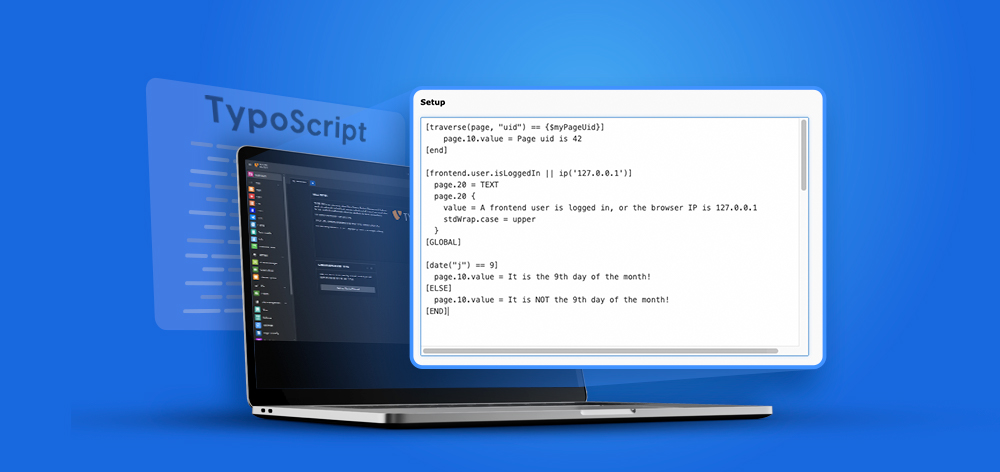
Modern TypoScript conditions help you write cleaner, safer, and more maintainable TYPO3 configuration. This guide is built as a practical cheatsheet, focused on real-world examples using Symfony Expression Language for fast copy-paste and immediate use.
Modern TypoScript conditions help you write cleaner, safer, and more maintainable TYPO3 configuration. This guide is built as a practical cheatsheet, focused on real-world examples using Symfony Expression Language for fast copy-paste and immediate use.
Since TYPO3 v9.4 LTS, Symfony Expression Language powers modern TypoScript conditions and replaces legacy syntax. If you work with TYPO3 daily, you already know how critical conditions are for controlling rendering, environments, and behavior across projects.
Instead of theory, this guide focuses on how modern TypoScript conditions actually work, including variables, functions, custom conditions, and common pitfalls.
In this guide, we will walk through everything you need to use TypoScript conditions correctly, confidently, and upgrade-safe.
| Use Case | TypoScript Condition | Context |
| Check site language ID | [siteLanguage("languageId") == 1] | FE |
| Check site language title | [siteLanguage("title") == "English"] | FE |
| Check page UID | [page["uid"] == 17] | FE |
| Check multiple pages | [page["uid"] in [17,24]] | FE |
| Check page backend layout | [page["backend_layout"] == 1] | FE |
| Check root page | [tree.level == 0] | FE |
| Check if page is in rootline | [2 in tree.rootLineIds] | FE |
| Check frontend user logged in | [frontend.user.isLoggedIn] | FE |
| Check backend user logged in | [backend.user.isLoggedIn] | BE |
| Check backend admin user | [backend.user.isAdmin] | BE |
| Check application context | [applicationContext == "Development"] | FE / BE |
| Check production environment | [applicationContext matches "#^Production#"] | FE / BE |
| Check TYPO3 version | [compatVersion("11.5")] | FE / BE |
| Check domain / host | [like(request.getNormalizedParams().getHttpHost(), "*.example.com")] | FE |
| Check HTTPS | [request.getNormalizedParams().isHttps()] | FE |
| Check query parameter | [request.getQueryParams()['foo'] == 1] | FE |
| Check current weekday | [date("w") == 5] | FE |
| Check site identifier | [site("identifier") == "mysite"] | FE |
| Check workspace | [workspace.isLive] | FE / BE |
| Check frontend user group | [usergroup("12")] | FE |
Symfony Expression Language–based TypoScript conditions are the modern, supported way to write conditions in TYPO3. They replace legacy condition syntax and are stable across current LTS versions.
| TYPO3 Version | Support | Notes |
| TYPO3 8 LTS | No | Legacy TypoScript conditions only |
| TYPO3 9.0–9.3 | No | Symfony Expression Language not available |
| TYPO3 9.4 LTS | Yes | First release with modern conditions |
| TYPO3 10 LTS | Yes | Fully stable |
| TYPO3 11 LTS | Yes | Recommended for production |
| TYPO3 12 LTS | Yes | Current best practice |
Use only Symfony Expression Language for new and updated projects.
TYPO3 integrates selected Symfony components to strengthen its core architecture without adding unnecessary complexity.
Condition logic is exposed through variables and functions, enabling cleaner configuration, easier extension, and fully upgrade-safe custom conditions aligned with TYPO3’s long-term roadmap.
TYPO3 replaced legacy TypoScript conditions with Symfony Expression Language to introduce a unified, extensible, and future-proof syntax.
Below is a direct before - after comparison, showing how common conditions translate from legacy syntax to modern TYPO3 (≥ 9.4).
TYPO3 ≤ 9.3 (Legacy)
Conditions were evaluated individually and chained together.
[condition1] && [condition2]
TYPO3 ≥ 9.4 (Symfony-based)
Conditions are evaluated as a single expression.
[condition1 && condition2]
Legacy
[globalVar = GP:L = 1]
Modern
[siteLanguage("languageId") == 1][siteLanguage("title") == "English"][siteLanguage("locale") == "en_US.UTF-8"]
Legacy
[globalVar = LIT:1 = {$myConstant}]
Modern
[{$myConstant} == 1]
Legacy
[globalVar = TSFE:id = 17][globalVar = TSFE:id = 17, TSFE:id = 24]
Modern
[page["uid"] == 17][page["uid"] in [17,24]][getTSFE().id == 17][getTSFE().id in [17,24]]
Legacy
[page|backend_layout = 1]
Modern
[page["backend_layout"] == 1]
Legacy
[globalString = IENV:HTTP_HOST = *.example.com]
Modern
[like(request.getNormalizedParams().getHttpHost(),"*.example.com")]
Legacy
[dayofweek = 5]
Modern
[date("w") == 5]
Legacy
[globalVar = GP:tx_extkey|param > 0]
Modern
[(request.getQueryParams()['tx_extkey'])['param'] > 0]
Modern TypoScript conditions expose variables and functions through Symfony Expression Language. Both are used inside condition expressions, but they serve different purposes.
Variables
Variables represent available runtime data and are used for direct comparisons.
Characteristics
Typical use cases
Example:
[page["uid"] == 1]
Functions
Functions encapsulate logic or processing and may accept parameters.
Characteristics
Typical use cases
Example:
[date("w") == 5]
Use variables for simple checks and functions for dynamic or computed conditions. The sections below are grouped accordingly.
TYPO3 provides a set of built-in variables that can be used directly in modern TypoScript conditions. These variables expose runtime information and are evaluated using Symfony Expression Language.
Each variable below represents a data source, not executable logic.
applicationContext - Application EnvironmentReturns the current TYPO3 application context as a string.
Common use cases
[applicationContext == "Development"][applicationContext matches "#^Development#"][applicationContext matches "#^Production/Dev#"][applicationContext matches "#^Production/(Dev|Staging)#"][applicationContext matches "#^Production/Live#"][applicationContext == "Production/Live/ClusterServer1"][applicationContext matches "#^Production/Live#" && getTSFE().isBackendUserLoggedIn()][not (applicationContext matches "#Production#")]
page - Page PropertiesProvides access to the current page record as an array.
Common use cases
[page["pid"] == 2][page["uid"] == 17][page["backend_layout"] == 1]
{$foo.bar}All TypoScript constants are available inside conditions. Be mindful of data types when comparing values.
[{$foo.bar} == 4711]["{$foo.bar}" == "4711"]
tree - Page Tree InformationProvides access to page tree and rootline data.
Common use cases
[tree.level == 0][tree.rootLine[0]["uid"] == 1][2 in tree.rootLineIds]
backend - Backend User Context (BE Only)Exposes backend user information. Available only in Backend context.
[backend.user.isAdmin][backend.user.isLoggedIn][backend.user.userId == 5][like("," ~ backend.user.userGroupList ~ ",", ",1,")]
frontend - Frontend User Context (FE Only)Exposes frontend user authentication data. Available only in Frontend context.
[frontend.user.isLoggedIn][frontend.user.userId == 5][like("," ~ frontend.user.userGroupList ~ ",", ",1,")]
typo3 - TYPO3 Environment InformationProvides TYPO3 system-level metadata.
[typo3.version == "10.4.2"][typo3.branch == "10.4"][typo3.devIpMask == "192.168.0.100"]
workspace - TYPO3 Workspace ContextExposes workspace-related information. Primarily used in Backend context.
[workspace.workspaceId == 1][workspace.isLive][workspace.isOffline]
Frontend-only conditions are evaluated during Frontend rendering and depend on an active HTTP request and an initialized TSFE (TypoScript Frontend Controller).
If evaluated in Backend, CLI, or Scheduler, these conditions will always resolve to false.
Frontend conditions are available:
They rely on:
Used to evaluate frontend user state and permissions.
[frontend.user.isLoggedIn][frontend.user.userId == 5][usergroup("12")][loginUser("*")][loginUser("3,7,9")]
Notes
These conditions rely directly on the TSFE object.
[getTSFE().page["uid"] == 1][getTSFE().id in [17,24]][getTSFE().isBackendUserLoggedIn()]
Notes
Used to evaluate request data, headers, and routing arguments.
[request.getQueryParams()['foo'] == 1][request.getParsedBody()['foo'] == 1][request.getHeaders()['Accept'] == 'json'][request.getCookieParams()['foo'] == 1][request.getPageArguments().get('foo_id') > 0][request.getNormalizedParams().isHttps()][request.getNormalizedParams().getHttpHost() == "t3planet.com"]
Notes
Available only after site configuration is resolved.
[site("identifier") == "t3terminal"][site("base").getHost() == "t3planet.com"][site("rootPageId") == 1][siteLanguage("languageId") == 0][siteLanguage("locale") == "de_CH"][siteLanguage("title") == "German"]
Notes
Used to read values from the TYPO3 FE session.
[session("session:foo|bar") == 1234567]
Notes
Backend-only conditions are evaluated inside TYPO3 Backend context, where TSFE does not exist.
They depend on:
Used to control backend-specific TypoScript logic.
[backend.user.isLoggedIn][backend.user.isAdmin][backend.user.userId == 5][backend.user.userGroupList matches "/,1,/"]
Notes
Used to differentiate live and non-live workspaces.
[workspace.isLive][workspace.workspaceId == 1]
Notes
These functions are context-agnostic but depend on available runtime data.
[date("d.m.") == "05.04.2019"][date("j") == 7][like("foobarbaz", "*bar*")][like("fooBarBaz", "/f[o]{2,2}[aBrz]+/")][traverse(request.getQueryParams(), 'tx_news_pi1/news') > 0][ip("172.18.*")][ip("devIP")][compatVersion("11.5")][getenv("VIRTUAL_HOST") == "t3planet.de"]
Most TypoScript condition issues fail silently. The following problems account for the majority of real-world bugs.
getTSFE() Always Returns falseWhat happens
Conditions using getTSFE() never match.
Why it happens
How to avoid
What happens
Conditions always evaluate to false.
Why it happens
frontend.* used in Backendbackend.* used in FrontendHow to avoid
site() or siteLanguage() Returns nullWhat happens
Language or site-based conditions do not match.
Why it happens
How to avoid
What happens
Condition looks correct but never matches.
Why it happens
How to avoid
What happens
Request-based conditions fail unexpectedly.
Why it happens
How to avoid
TypoScript conditions are powerful, but they are configuration tools, not a place for business logic. Using them correctly improves performance, upgrade safety, and long-term maintainability.
Use TypoScript conditions when you need to control configuration, not application behavior.
Recommended usage
Guidelines
Avoid TypoScript conditions when logic becomes dynamic, complex, or data-dependent.
Do not use conditions for
Better alternatives
| Requirement | Recommended Solution |
| Business logic | PHP services |
| Personalization | Controllers / ViewHelpers |
| Runtime decisions | Middleware |
| Feature toggles | Configuration or feature flags |
| Heavy logic | Cached configuration |
Rule of thumb
If a condition:
It probably does not belong in TypoScript.
One of the biggest advantages of modern TypoScript conditions is the ability to define custom conditions. Unlike legacy userFunc–based conditions, Symfony Expression Language allows clean, reusable, and upgrade-safe extensions.
TYPO3 ≤ 9.3 (Legacy)
[userFunc = \Vendor\Extension\UserFunc\MyUserFunc('foo')]
TYPO3 ≥ 9.4 (Modern)
[variableA === 'valueB']
Modern conditions are:
Register your custom provider inside the extension configuration.
File: Configuration/ExpressionLanguage.php
<?phpreturn ['typoscript' => [\Vendor\ExtensionName\ExpressionLanguage\CustomTypoScriptConditionProvider::class,]];
This makes your variables or functions available to TypoScript conditions.
Create a provider that exposes variables to the expression language.
File: Classes/ExpressionLanguage/CustomTypoScriptConditionProvider.php
<?phpnamespace Vendor\ExtensionName\ExpressionLanguage;use TYPO3\CMS\Core\ExpressionLanguage\AbstractProvider;class CustomTypoScriptConditionProvider extends AbstractProvider{public function __construct(){$this->expressionLanguageVariables = ['variableA' => 'valueB',];}}
Key points
Once registered, the variable can be used like any built-in condition.
[variableA === 'valueB']page >page = PAGEpage.10 = TEXTpage.10.value = Matched[GLOBAL]
The condition is evaluated using Symfony Expression Language and behaves consistently across TYPO3 versions.
TYPO3 also allows you to register custom expression functions, not just variables. This is an advanced technique and should be used only when simple variables are not sufficient.
This approach is suitable for:
Use a custom function when:
Do not use this for:
Create a provider that registers a custom function for TypoScript conditions.
<?phpnamespace Vendor\ExtensionName\TypoScript;use Symfony\Component\ExpressionLanguage\ExpressionFunction;use Symfony\Component\ExpressionLanguage\ExpressionFunctionProviderInterface;use TYPO3\CMS\Core\Utility\GeneralUtility;class CustomConditionFunctionsProvider implements ExpressionFunctionProviderInterface{public function getFunctions(): array{return [$this->getWebserviceFunction(),];}protected function getWebserviceFunction(): ExpressionFunction{return new ExpressionFunction('webservice',function () {// Compiler not required for TypoScript usage},function ($existingVariables, string $endpoint, int $uid) {return GeneralUtility::getUrl('https://t3planet.de/en/endpoint/' . $endpoint . '/' . $uid);});}}
Important notes
Once registered, the function behaves like a native condition function.
[webservice('pages', 10)]page.10 >page.10 = TEXTpage.10.value = Matched[GLOBAL]
You can also compare the returned value explicitly.
[webservice('pages', 10) === 'Expected title']page.10 >page.10 = TEXTpage.10.value = Matched[GLOBAL]
Best practice
If a condition becomes hard to reason about, it likely belongs in:
Modern TypoScript conditions based on Symfony Expression Language are the recommended and future-safe approach for configuring TYPO3 projects. They offer cleaner syntax, better readability, and a consistent evaluation model across Frontend and Backend.
If you’re maintaining existing TYPO3 sites, migrating legacy conditions to modern syntax should be part of every upgrade strategy. This reduces technical debt, prevents silent failures, and keeps your configuration aligned with current TYPO3 standards.
Use TypoScript conditions where they make sense, for configuration, not business logic, and always validate them during major TYPO3 upgrades. With the right structure and discipline, modern conditions become a powerful and reliable tool in everyday TYPO3 development.
Modern TypoScript conditions use Symfony Expression Language (introduced in TYPO3 v9.4) to evaluate logic in a single, readable expression. They replace legacy condition syntax and are upgrade-safe.
Legacy conditions like [globalVar] and [userFunc] are deprecated. They may still work in older TYPO3 versions, but should not be used in new projects or upgrades.
Yes, but not all conditions work everywhere. Some are Frontend-only (e.g. getTSFE(), siteLanguage()), while others are Backend-only (e.g. backend.user.*, workspace.*).
getTSFE() is available only during Frontend rendering. If the condition runs in Backend, CLI, or Scheduler context, it will always evaluate to false.
Create custom conditions only for configuration-level decisions that cannot be expressed with built-in variables or functions. Avoid using them for business logic or performance-critical checks.
Yes. TypoScript conditions are evaluated frequently, which is why they should remain simple, deterministic, and fast. Heavy logic or external calls can negatively impact performance.

Wolfgang Weber
Brand & Communication LeadWolfgang Weber shapes TYPO3 with passion and expertise. As TYPO3 enthusiast, he has contributed to TYPO3 projects that make websites faster and more secure. Outside of TYPO3, you'll probably find him exploring local cafés and…
More From Author