Fast and reliable customer support in a digital world is the lifeblood of companies providing software as a service (SaaS). Research shows that 90% of customers think that a quick answer is “important” or “very important” when they have an issue.
Table Of Content
If not, they may lose confidence in the product and switch to another one.
SaaS businesses rely on retention and continuous value. Users expect quick support for issues, as prompt solutions enhance efficiency, reduce frustration, and maintain loyalty.
Additionally, fast-support companies likely to get higher satisfaction scores, lower support costs, and brand equity than those who are dependent on slow and manual support systems.
With instant help in the SaaS world, we’ll find out what direct communication means for a SaaS, the technologies behind it, the challenges it brings, and how companies can measure and improve response speed.
The New Standard: Speed, Accuracy, and 24/7 Availability
Customer support has become a defining factor for SaaS success. In a market where users can switch tools easily, speed, accuracy, and availability play a central role in how customers perceive value.
Let’s look at why these elements are now the new standard for customer loyalty and business growth.
Why fast, accurate, and always-on support defines customer loyalty
Customers expect instant help: The 2024 Zendesk report claims that 73% of customers believe that companies must provide support 24 hours a day, 7 days a week. They need their queries to be solved quickly, not to wait for a long time.
Speed builds trust: Quick responses are a sign of the company's reliability and professionalism. When customers receive their issues resolved promptly, they become loyal to the company.
Accuracy drives satisfaction: The point is not only about being quick, but also helpful and correct are the responses. Users inaccuracy of replies can be more irritated than delays.
Consistency matters: Offering support at any time of the day or night is the guarantee that users from different time zones or shifts get the same level of service.
To sum up, rapid, correct, and even-on assistance are the main factors that keep the customer loyalty in the SaaS market which is getting more and more competitive.
How SaaS brands lose customers due to response delays
User frustration grows quickly: Studies show that 50% of users expect an initial reply within 5 minutes, especially for technical or billing issues.
Negative experiences compound: One slow or incomplete response can lead to dissatisfaction, but repeated delays often push users to competitors.
Perception of unreliability: When support is slow, customers often assume the product itself is unreliable or poorly managed.
Easy switching costs: With many SaaS tools offering free trials or easy data migration, it only takes a few clicks for users to leave.
Response delays are not just operational problems, they directly impact retention and long-term brand reputation.
The business cost of slow support
Higher churn rates: Research from HubSpot shows that 80% of customers stop doing business with a company after multiple poor experiences. Even one bad support interaction can trigger cancellations.
Lost conversions: Poor reviews and low ratings from delayed support can reduce new sign-ups by up to 30%, according to several customer success surveys.
Increased support costs: The longer an issue remains unresolved, the more resources it consumes. Teams spend extra time managing frustrated customers instead of preventing problems.
Damage to brand image: In SaaS, reputation spreads quickly. Public complaints or low ratings can discourage potential clients and hurt credibility.
For SaaS companies, slow support isn’t just an inconvenience, it’s a direct financial and reputational risk.
What Is T3AC? A Quick Overview of TYPO3’s AI Chatbot Extension
T3AC is an AI-powered chatbot extension designed for the TYPO3 content management system (CMS). It allows website owners to integrate automated, intelligent customer assistance directly into their TYPO3 websites, without relying on external SaaS platforms.
By operating locally within the TYPO3 environment, T3AC offers a more secure, customizable, and data-conscious approach to delivering real-time support.
Introduction to T3AC and its integration with TYPO3 CMS
Built for TYPO3: T3AC functions as a native TYPO3 extension, meaning it installs and runs inside the same system rather than connecting to a third-party dashboard. This makes setup, management, and updates seamless for TYPO3 administrators.
Easy deployment: The extension can be installed directly via the TYPO3 Extension Manager. Once configured, it can be placed on any page or section of the website to provide real-time chat assistance to visitors.
Full control over data: Unlike cloud-based tools that send information to external servers, T3AC keeps user interactions, chat history, and data storage within the local TYPO3 system. This setup supports stronger data protection and helps meet GDPR compliance requirements.
This integration ensures that businesses using TYPO3 can offer automated support without adding complex external dependencies or sacrificing control over customer data.
The vision behind T3AC: bridging AI and customer support
Purpose-built for practicality: T3AC aims to bring AI capabilities to everyday website management, helping organizations automate responses, guide users, and reduce the load on human support teams.
Smarter customer interaction: It uses AI models (such as those powered by OpenAI APIs) to understand user intent, provide accurate answers, and continuously improve responses based on stored knowledge.
Focus on efficiency: The goal is not to replace human agents but to enhance their efficiency by handling simple or repetitive questions instantly, freeing up teams to focus on complex issues.
T3AC bridges the gap between artificial intelligence and customer communication, making intelligent support more accessible to TYPO3 users without requiring deep technical knowledge.
Why TYPO3 users prefer native AI solutions over third-party SaaS bots
Data privacy and compliance: TYPO3 is widely used in Europe, where data protection laws such as GDPR are critical. A native AI solution like T3AC ensures all data stays within the organization’s infrastructure.
Performance and reliability: Local hosting minimizes latency and dependency on external networks, providing a faster and more consistent chat experience.
Customization and flexibility: TYPO3 users often require tailored site experiences. A native extension can be fully customized to match the site’s design, tone, and content structure.
Cost efficiency: Since T3AC runs within existing TYPO3 setups, companies avoid recurring SaaS subscription fees and gain predictable operational costs.
For many TYPO3-based organizations, a self-contained AI chatbot offers the best balance between automation, compliance, and control, making it an appealing alternative to cloud-only customer service tools.
Core Features That Empower SaaS Businesses
T3AC includes several key features designed to make customer assistance faster, smarter, and more efficient. These features align well with the daily needs of SaaS companies that depend on reliability, user trust, and global accessibility.
Below is an overview of how each capability supports modern customer support operations.
AI-Powered Instant Customer Assistance
Real-time responses: T3AC uses AI technology (through OpenAI integration) to respond to user queries instantly, reducing waiting time and improving the overall support experience.
Efficient query handling: Routine and repetitive questions, such as login help, pricing details, or setup instructions, can be handled automatically. This lowers the workload on support agents and ensures users receive help immediately.
Consistent quality: The AI delivers uniform answers based on stored information, helping companies maintain consistent tone and accuracy across all interactions.
This combination of automation and intelligence allows SaaS businesses to maintain high-quality service while keeping response times short.
No SaaS Dependency , Full Data Control & GDPR Compliance
Local data storage: All user interactions, chat histories, and knowledge base data are stored directly within the TYPO3 environment, giving organizations complete control.
Privacy-first operations: Since data doesn’t leave the company’s servers, risks linked to third-party storage or data sharing are minimized.
Regulatory compliance: This setup naturally supports GDPR and other regional privacy laws, which is essential for companies operating in Europe and beyond.
For SaaS companies handling sensitive customer information, this self-hosted model helps maintain compliance while ensuring transparency and control.
Retrieval-Augmented Knowledge Base (RAG) for Accurate Replies
Source-based learning: T3AC can train its AI responses using existing website content, uploaded files, and documentation. This ensures users get answers derived from verified internal sources.
Context-aware support: The system retrieves relevant information dynamically, so replies reflect accurate product or policy details.
Brand consistency: By using company-approved materials, all messages align with the organization’s tone and knowledge standards.
With RAG, customer responses remain both factual and consistent, reducing the risk of misinformation or confusion.
Automatic Crawling and Knowledge Updates
Scheduled content updates: The chatbot automatically crawls the website at set intervals to refresh its knowledge base.
Minimal manual effort: This reduces the need for frequent manual retraining or data uploads, keeping the system current with minimal supervision.
Always relevant: Users receive up-to-date information on new features, policies, or announcements without additional configuration.
Automatic updates help SaaS teams maintain accurate, reliable customer information while focusing on other operational priorities.
Advanced Chat Analytics and Insights
Conversation tracking: T3AC records chat histories and queries, providing insights into what users ask most frequently.
Trend analysis: Teams can identify common pain points or recurring technical issues.
Data-driven improvement: The analytics help refine product documentation, FAQ pages, and chatbot prompts based on real customer interactions.
By using these insights, SaaS companies can continuously improve their support quality and product experience.
Multilingual Support for Global SaaS Markets
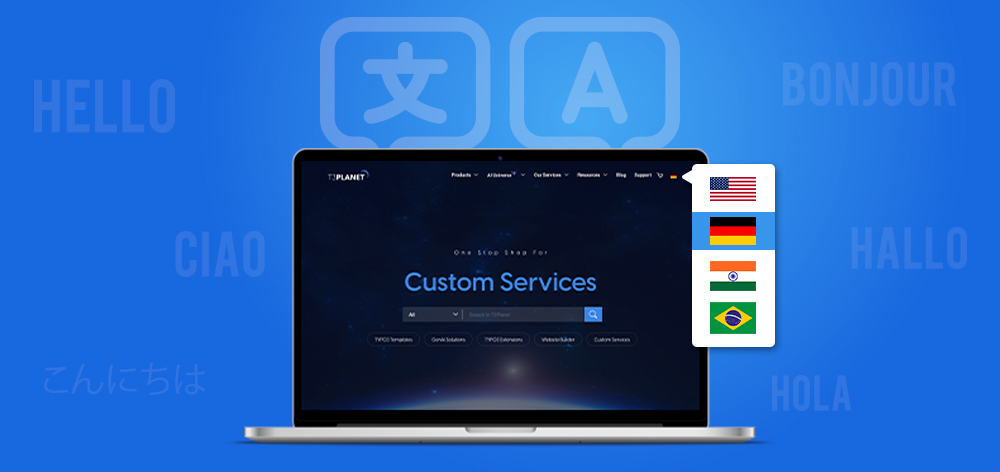
Multi-language responses: T3AC supports several languages, allowing users to interact in their preferred language.
Localized assistance: This is particularly useful for SaaS platforms serving diverse or international audiences.
Unified management: Administrators can manage all translations and interactions through a single TYPO3 backend, ensuring efficiency.
For SaaS brands operating across regions, multilingual support ensures inclusivity and helps maintain consistent service quality worldwide.
These features collectively help SaaS companies provide instant, secure, and personalized customer support. With automation, local data control, and multilingual flexibility, T3AC aligns with the modern standards of global, privacy-conscious, and customer-first SaaS operations.
How T3AC Transforms SaaS Customer Support Workflows
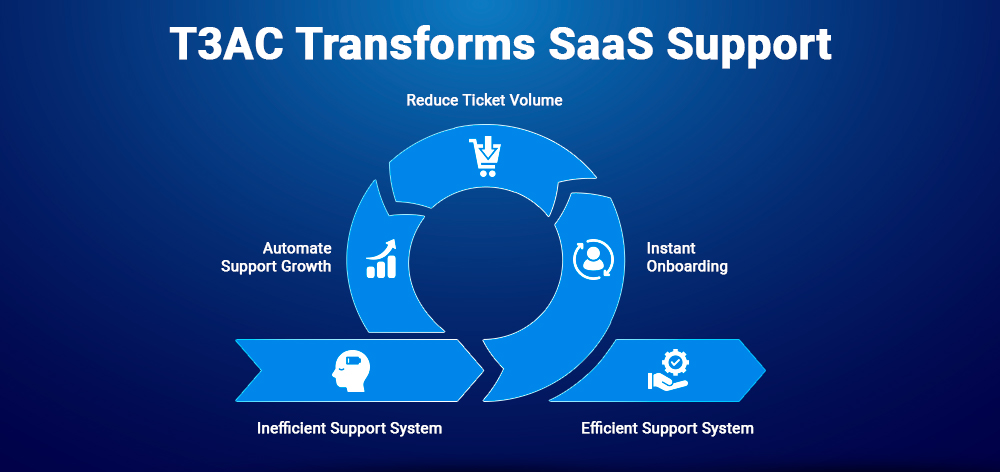
T3AC helps SaaS companies build more efficient, scalable, and user-friendly support systems. By combining automation with intelligent response handling, it simplifies everyday workflows and reduces the pressure on human support teams.
Instant Onboarding and Training for New Users
Provides interactive onboarding directly on the website, guiding users through setup and key features.
Delivers real-time answers to product questions, helping new customers learn faster.
Ensures consistent, accurate guidance by using approved content instead of manual explanations.
Result: Faster onboarding, fewer setup-related tickets, and a smoother early user experience.
Reducing Ticket Volume and Support Overhead
Handles repetitive questions automatically, such as account help or troubleshooting steps.
Offers 24/7 self-service support, reducing reliance on live agents.
Minimizes support backlogs by solving common issues instantly.
Result: Lower operational costs, shorter response times, and more focused human support teams.
Scaling Support Without Expanding Headcount
Automates support growth to match user base expansion without new hires.
Delivers consistent service quality regardless of traffic volume.
Frees human agents to manage complex or high-priority inquiries.
Result: Sustainable growth with efficient, high-quality customer support operations.
Why SaaS Companies Prefer T3AC Over Traditional Chatbots
Limitations of SaaS-based chatbots (cost, privacy, lock-in)
Layered/usage costs: Popular SaaS chat platforms combine seat fees with add-ons and usage (e.g., AI resolutions, channels), which can raise total cost as volume grows.
Vendor data processing: Customer data is processed on the vendor’s cloud; compliance is supported by DPAs and controls, but data still leaves your infrastructure.
Ecosystem lock-in: Workflows, automations, and reporting are tied to the vendor stack, making migrations harder over time (pricing and features may change).
Benefits of a self-hosted TYPO3 extension (T3AC)
Local data control: Chats, knowledge, and logs remain inside TYPO3, supporting privacy-first operations and reducing third-party exposure.
TYPO3-native management: Install and manage via TYPO3 tools and docs; fewer external dashboards.
Flexible cost posture: You manage infrastructure and your LLM usage; fewer layered platform add-ons compared with typical SaaS bundles. (Inference based on T3AC’s self-hosted model vs SaaS pricing structures.)
Long-term ROI and cost efficiency for growing SaaS teams
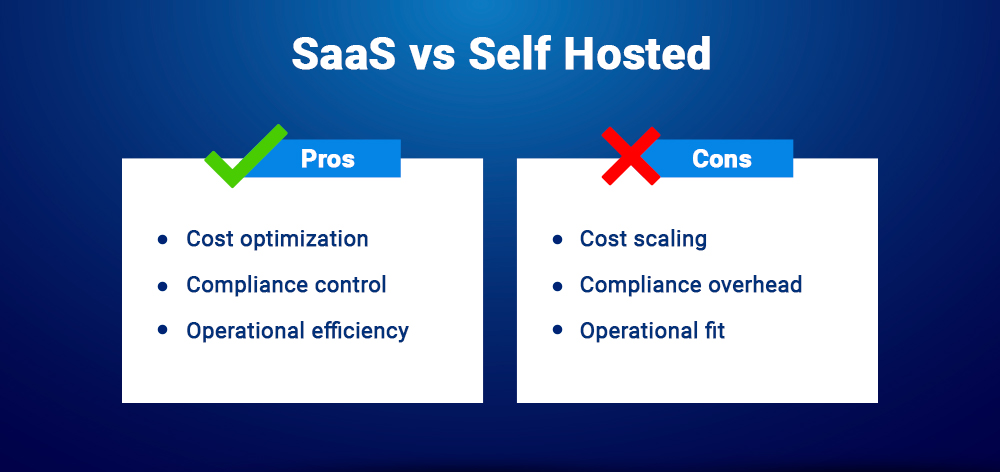
Cost scaling: Seat + usage pricing can rise with volume (agents, sessions, AI resolutions, channels). Self-hosted models shift spend toward infrastructure and API usage, which some teams can optimize.
Compliance overhead: Keeping data in your CMS may reduce vendor assessments and cross-border data reviews, though you must still manage your own security.
Operational fit: TYPO3-native workflows can cut context-switching and speed updates; SaaS tools offer rich ecosystems and faster out-of-the-box channels, evaluate based on team skills and stack.
Getting Started with T3AC in TYPO3
T3AC can be set up in TYPO3 with minimal technical effort. Here’s a concise overview of the main steps to begin using it effectively.
Installation
Access the Extension Manager in TYPO3 and install the T3AC extension.
Activate it and clear the cache.
A new T3AC module appears in the backend for configuration and management.
Configuration and Training
Enter your OpenAI API key to enable AI responses.
Upload relevant documents or content to build the knowledge base.
Adjust tone, permissions, and chatbot settings as needed.
Test responses before going live.
Website Integration
Add the chat widget to selected pages via TYPO3’s content elements.
Customize colors, text, and placement to fit your website design.
Enable it site-wide or on specific pages for targeted support.
Access detailed documentation and support from T3Planet during setup.
Conclusion
The customer support landscape in SaaS is shifting rapidly toward AI-powered, privacy-conscious solutions. Users expect instant, accurate, and secure assistance at all times, something traditional models often struggle to deliver.
T3AC represents this new approach by bridging human expertise with intelligent automation. It handles repetitive, time-sensitive queries instantly while allowing support teams to focus on complex or high-value interactions.
This balance improves both efficiency and user satisfaction. By combining local data control, real-time responsiveness, and seamless TYPO3 integration, T3AC reflects what modern SaaS support should look like, fast, compliant, and reliable.
FAQs
T3AC runs natively within TYPO3, storing all data locally. This self-hosted model offers better control, stronger privacy, and smoother integration compared to external SaaS chatbots.
All chat data remains on the organization’s TYPO3 server, avoiding external data transfers. This setup supports compliance with GDPR and similar privacy regulations.
Yes. T3AC supports multilingual responses, making it suitable for SaaS companies serving international users.
No. It installs through the TYPO3 Extension Manager and can be configured via the backend without any coding.
RAG allows the chatbot to use your website’s content and uploaded documents to generate accurate, context-based responses.
ROI can be tracked through reduced ticket volume, faster response times, higher user satisfaction, and lower support costs over time.
Jürgen is a TYPO3 AI Consultant at AI Universe. He helps businesses make the most of their TYPO3 websites by integrating AI-powered solutions. From smart content creation and automated SEO improvements to seamless chatbot…
Thank you for your comment. Your Comment Added Successfully.
Thank you for your comment. Your Comment Will Be Visible After Approval.
Oops! Something went wrong, please try again later.
Thank you for your comment. Your Comment Added Successfully.
Anja Durr
2026-01-30 At 9:11 am
The blog helped me to understand why instant support matters for SaaS products. I liked how it explained down T3AC in a practical way, showing how users get faster help and teams save time on daily support tasks.
Thank you for your comment. Your Comment Added Successfully.





Jürgen Pietschmann
TYPO3 AI ConsultantJürgen is a TYPO3 AI Consultant at AI Universe. He helps businesses make the most of their TYPO3 websites by integrating AI-powered solutions. From smart content creation and automated SEO improvements to seamless chatbot…
More From Author