
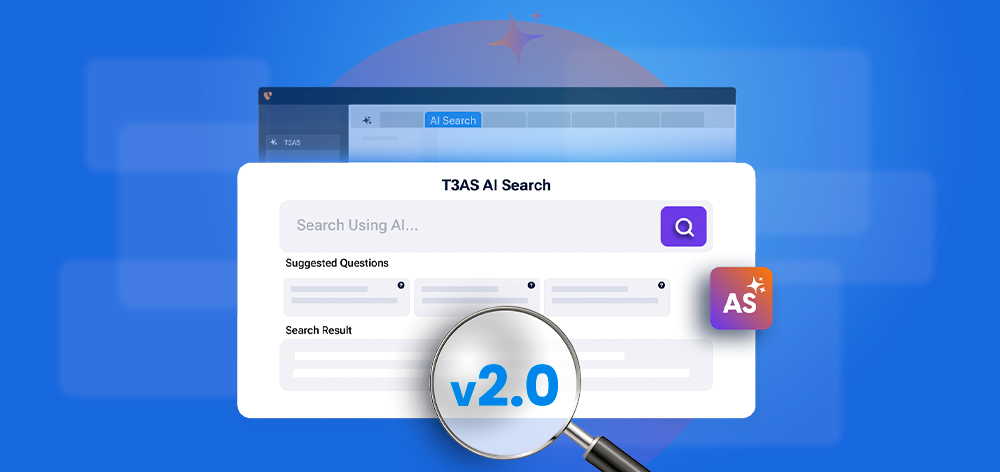
T3AS 2.0: AI Search for Better Discovery, Relevance and Conversion
AI


Artificial intelligence is transforming how teams create content, design interfaces, and streamline workflows. From faster drafts to smarter SEO suggestions, AI is becoming a powerful companion in modern digital projects
Artificial intelligence is transforming how teams create content, design interfaces, and streamline workflows. From faster drafts to smarter SEO suggestions, AI is becoming a powerful companion in modern digital projects.
But as organizations adopt AI tools, one thing remains clear: enterprise websites still need a stable, secure, and well-governed foundation. TYPO3 provides exactly that foundation, offering structure, governance, multilingual workflows, and long-term stability that AI alone cannot replace.
This guide explores how AI and TYPO3 work best together, where AI adds real value, and why TYPO3 continues to be a future-ready platform for serious digital projects.
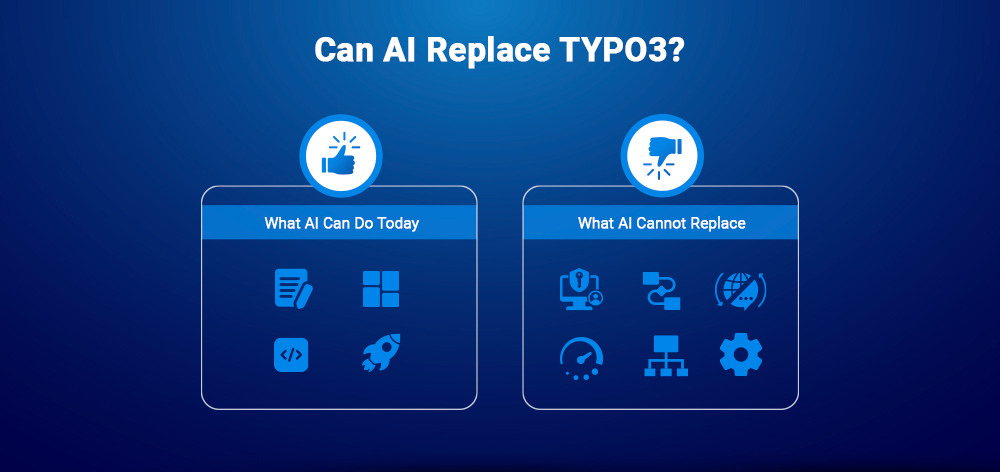
No, AI won't replace TYPO3, especially for big companies.
AI speeds up making websites. It helps write content, design layouts, assist with code, and quickly make prototypes. This really helps when starting out and making simple pages.
But a CMS isn't just about page creation; it's about managing them over time. Big company websites need structure, control, and stability. They need to handle many editors, approvals, different languages, security, SEO, and a design that can grow.
This cuts down on work and speeds up projects.
AI creates the front view of the site, but TYPO3 handles the structure underneath. For companies that need control, compliance, and the ability to grow, that structure is very important.
AI can generate content, layouts, and even working frontend code.
But generation is only the first step. After content is created, it must be stored, structured, reviewed, secured, and maintained.
That is where a CMS like TYPO3 becomes essential.
AI is a productivity layer. TYPO3 is the operational system it needs to land in.
When AI produces a draft page or text, that output needs a structured home.
Without a CMS, AI-generated content becomes isolated fragments.
With TYPO3, content is stored in structured models, organized consistently, and managed within a controlled backend.
Creation without structure leads to chaos. Structure enables scale.
Enterprise websites are rarely managed by one person.
AI does not manage:
TYPO3 does.
This ensures that AI-assisted content still follows governance rules and accountability standards.
The real test of any digital system is not launch day. It is a long-term operation.
AI can accelerate today’s work.
But it does not maintain systems over time.
Nobody tears out the foundation of a building just because new tools appear. You improve what sits on top of it.
AI modernizes creation.
TYPO3 remains the foundation that keeps the system stable for years.
As AI tools become more powerful, assumptions spread quickly.
In practice, most of these assumptions confuse content generation with system management.
Here are three common misconceptions, and the reality behind them.
AI can create web pages, layouts, and even organize content. That's not science fiction.
But running a website is more than just building it.
Websites need things like:
AI can make stuff, but it can't really manage all the rules and processes.
A CMS like TYPO3 gives you the tools to keep things organized, safe, and under control for the long haul.
People often get speed wrong.
AI makes content creation faster. A CMS makes sure that things stay stable, organized, and secure.
Modern TYPO3 setups work well with:
TYPO3 doesn't slow AI down. It just makes sure the content AI makes fits into a system that's easy to manage and grow.
Headless setups separate the frontend from the backend.
But you still need a backend.
Even when AI is involved in headless setups, you still need:
AI can quickly whip up frontend parts.
But where that content comes from still matters.
In headless setups, TYPO3 can still be the main content hub, even if the frontend is modern, flexible, or uses AI.
AI and TYPO3 are not competitors. They solve different parts of the same problem.
AI accelerates creation.
TYPO3 ensures structure, control, and long-term stability.
The difference becomes clearer when you look at specific areas of a project.
| Area | What AI Improves | Why TYPO3 Is Still Needed |
| Content | Drafting, summarizing, translation support | Workflows, approvals, versioning, structured storage |
| Frontend | Prototypes, layout suggestions, UI ideas | Clean CMS integration, long-term maintainability |
| Development | Code assistance, scaffolding, refactoring help | Secure architecture, update management, stability |
| Headless | Faster SPA and frontend acceleration | Structured API-based content source and governance |
| SEO | Title and meta suggestions | URL structure, multilingual logic, canonical control |
AI helps teams move faster.
TYPO3 ensures that what is built remains consistent, manageable, and secure.
For enterprise environments, both layers are useful, but they serve different responsibilities.
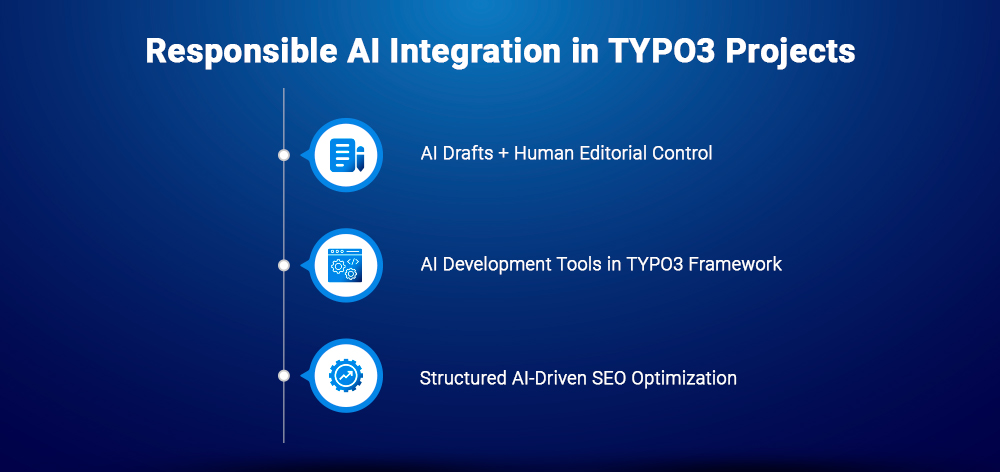
Using AI in enterprise projects is not about replacing systems. It is about integrating automation where it adds value, without losing control.
In structured environments built on TYPO3, AI works best when it supports teams while governance remains intact.
Here is what responsible integration looks like in practice.
AI produces initial drafts and summary texts and translation options. This decreases required work while increasing production speed.
In corporate settings:
The editorial process receives support from artificial intelligence. The system maintains its established procedures.
The process guarantees that all three elements, which include quality and lawful requirements and person accountability needs, are preserved.
AI tools provide developers with following capabilities
The final implementation should comply with TYPO3 architectural regulations
AI technology accelerates development processes. The organization of TYPO3 architecture defines its operational and maintenance requirements.
AI generates suggestions for
The enterprise SEO process needs to maintain
All SEO changes that occur within TYPO3 can be tracked through organized systems.
AI delivers suggestions while TYPO3 maintains its operational standards throughout the system.
Speed is not the only factor that determines responsible AI implementation.
The combination of productivity and governance represents the main objective.
AI technology empowers TYPO3 projects through its operational capabilities. The process creates technical debt, which results in operational risks for organizations.
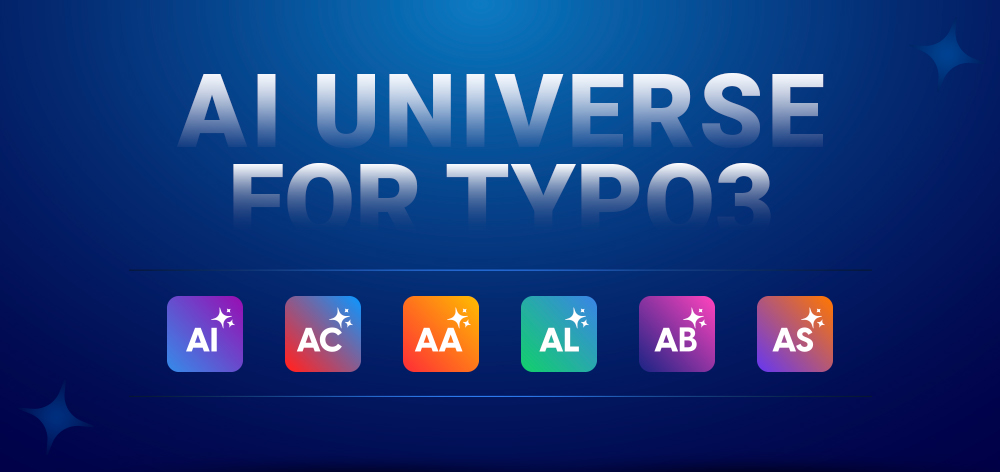
AI doesn't need to be some separate thing you tack onto your CMS. You can build it right into your TYPO3 setup.
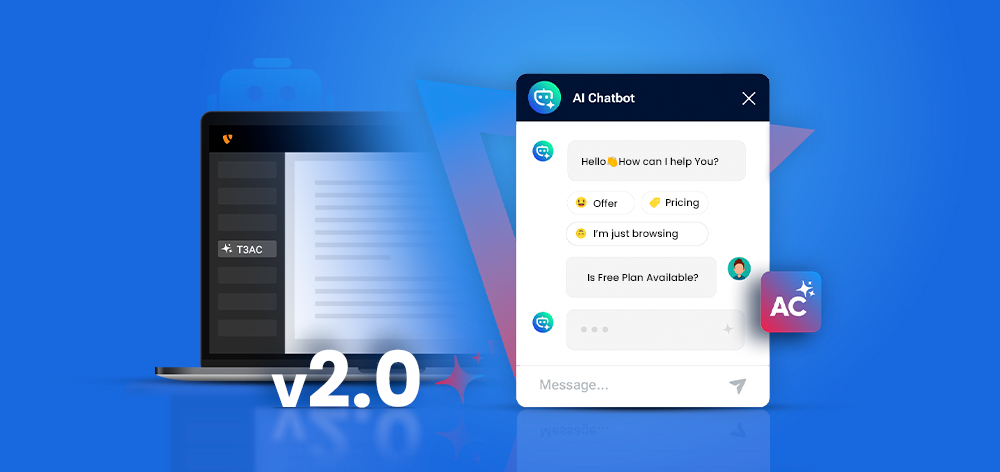
T3Planet's AI Universe for TYPO3 is a set of AI extensions made just for TYPO3. They don't try to take over your CMS. Instead, they work inside the TYPO3 backend and stick to how you already manage things.
The six extensions currently include:
All these extensions play nice with TYPO3's permissions, content structure, and how you usually work.
That's basically the point: AI is way more useful when it's part of your CMS, not when it tries to replace it.
Technology evolves quickly. Platforms that survive long-term are not the ones chasing trends, they are the ones designed to adapt.
TYPO3 has consistently evolved from a traditional CMS into a flexible enterprise content platform. This makes it well suited for integrating new technologies like AI without disrupting existing systems.
Modern digital projects use separate systems for their frontend and backend development work.
This system enables AI-generated or AI-assisted frontends to establish proper connections with a structured content backend system.
AI may accelerate frontend creation. TYPO3 remains the reliable content source behind it.
Large organizations need to use multiple editors for their operations.
TYPO3 provides:
The introduction of AI tools needs this governance model to operate effectively. The system supports automated content creation while retaining specified permission and control mechanisms.
Enterprise projects depend on predictable outcomes.
TYPO3 provides:
Public institutions and organizations in the DACH region need this stability because they must meet compliance regulations and develop their digital infrastructure for extended periods.
AI tools may change rapidly.
TYPO3 provides a secure framework which enables organizations to adopt new technologies while maintaining control over their systems.
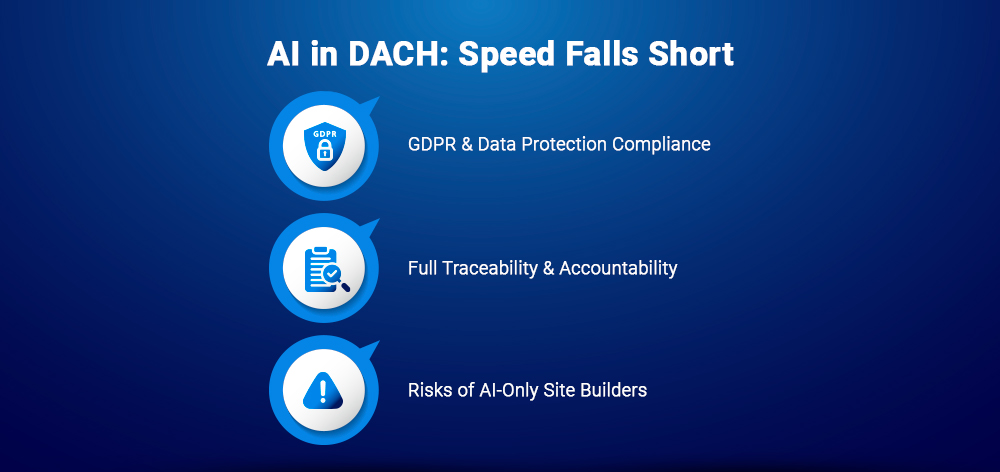
In Germany and across the DACH region, digital infrastructure is evaluated differently than in hype-driven markets.
Speed and automation are valued - but not at the expense of control, compliance, and long-term reliability. Enterprise platforms must meet regulatory standards and internal governance requirements.
This is where structured CMS platforms like TYPO3 remain critical.
Companies in Germany, Austria, and Switzerland (DACH) have to follow tough data protection laws, like GDPR.
This means being careful with:
AI interfaces don't solve all these issues by themselves. A well-managed CMS helps you control data flow, permissions, and how things work together to make sure you're doing things the right way.
Big companies and government groups need to know who is responsible for what.
AI doesn't automatically keep track of this stuff. TYPO3 gives you version control, user logs, and ways to control the workflow, so you always know what's going on.
AI website builders can make pages fast.
But, if you don't have a solid system behind the scenes, you might run into issues like:
For small, short-term stuff, this might be okay.
But for big company websites, government sites, and industries with lots of rules, it can cause problems.
In the DACH area, people want their digital stuff to be reliable, easy to audit, and able to be maintained, not just fast.
Not every project requires enterprise-level architecture.
There are situations where an AI-generated website or lightweight builder can be sufficient, especially when speed matters more than long-term governance.
The following items serve as examples:
Organizations use quick content creation methods to achieve their main content delivery objective.
The project needs a stable CMS system when it includes these elements:
AI-powered solutions function effectively only for basic tasks that require short-term use.
TYPO3 provides digital platforms with structured growth and regulatory needs a system foundation that guarantees sustainability.
The recognition of this distinction does not involve the rejection of AI technologies.
The correct degree of infrastructure should be applied to match the actual complexity of systems.
AI delivers the most value when it is integrated into structured workflows, not layered on top of disconnected tools. Within TYPO3, AI can support editors, developers, and SEO teams while governance, permissions, and long-term maintainability remain intact.
If you want to see how this works in practice, explore the AI Universe for TYPO3 and discover how AI capabilities can be embedded directly into TYPO3 projects without compromising structure or control.
No. AI does not replace TYPO3. AI can generate content, layouts, and code suggestions, but it does not manage permissions, workflows, versioning, or long-term governance. TYPO3 remains the structured foundation for enterprise websites.
No. AI enhances CMS platforms by improving productivity. It supports drafting, automation, and optimization tasks. However, a CMS is still required to manage structure, compliance, scalability, and long-term operations.
AI can generate a working prototype or frontend. However, enterprise websites require structured content storage, role-based permissions, approval workflows, and governance controls. These functions require a CMS.
Yes. TYPO3 supports API-first and headless architectures. AI-assisted frontends can connect to TYPO3 as a structured backend content source.
AI is most effective in content drafting, translation support, SEO suggestions, development assistance, and prototyping. Governance, publishing control, and long-term structure should remain managed by TYPO3.
AI can be used safely when integrated within controlled workflows. Permission systems, approval processes, and data protection policies must remain enforced by the CMS.
TYPO3 provides structured content models, version control, role management, and long-term support releases. These features ensure that websites remain stable, secure, and maintainable over time, even as new technologies like AI are introduced.
Help
English
Tools
Tools
move to sidebar hide
Actions
General https://xn--krakn29-uya.com