

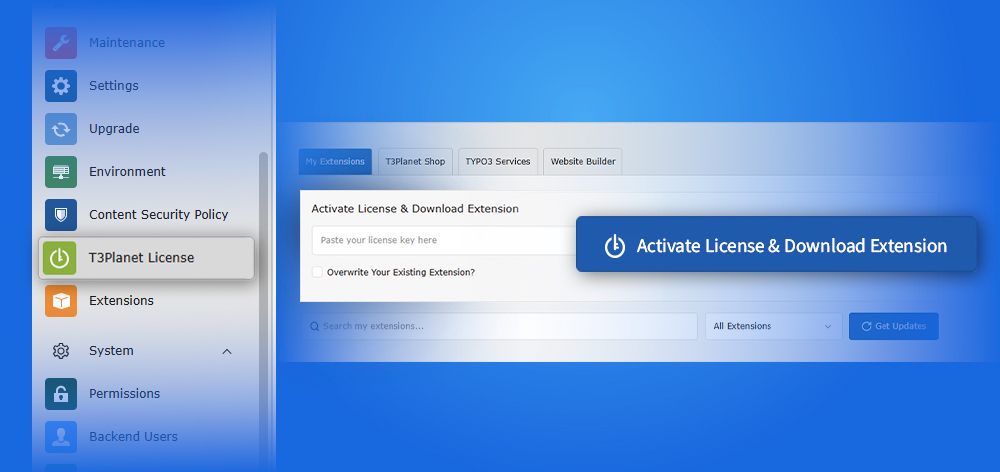
T3Planet License Manager Activation: A Complete Step-by-Step Guide
Extensions


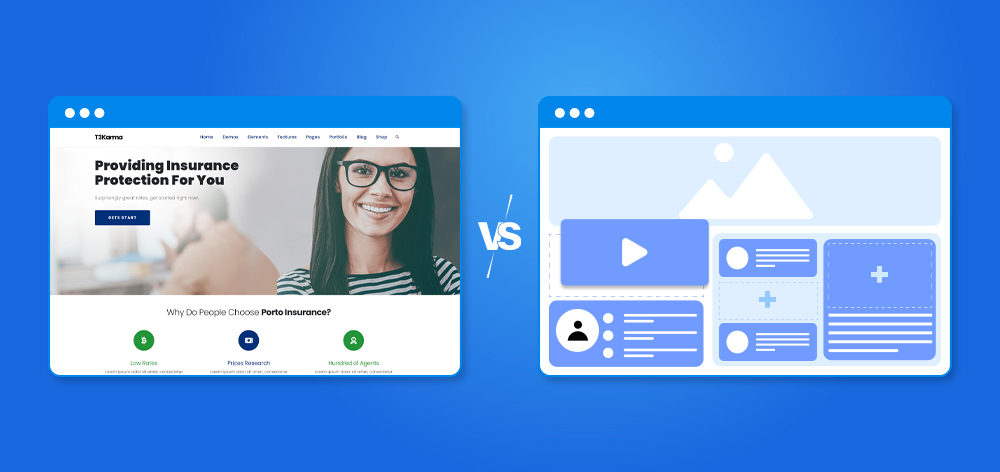
In TYPO3 projects, deciding between using a template or building something from scratch can be tough. What seems like a simple tech decision at first can become a cost and upkeep issue later.
Lots of teams pick custom development for flexibility or templates for speed. But they don't always think about how the site will change. When needs change, those early choices pop up again when you do TYPO3 LTS upgrades, redesigns, or add more content.
This guide tells you why the template vs. custom question keeps coming up in TYPO3 projects. It explains how bad choices can raise costs and make upgrades harder. It also shows how a structured template method like T3Karma can lower risk without cutting needed flexibility.
This guide is intended for TYPO3 teams making decisions that affect delivery speed, cost, and long-term maintenance. It focuses on repeatable project work, not isolated experiments.
This part tells you which TYPO3 teams will find this guide really helpful. It's all about work you do again and again, not those super unique projects.
This part shows when this guide might not be the best fit, and when custom TYPO3 work is the better choice.
In these cases, custom TYPO3 work is usually better for getting the design you want without struggling with template restrictions.
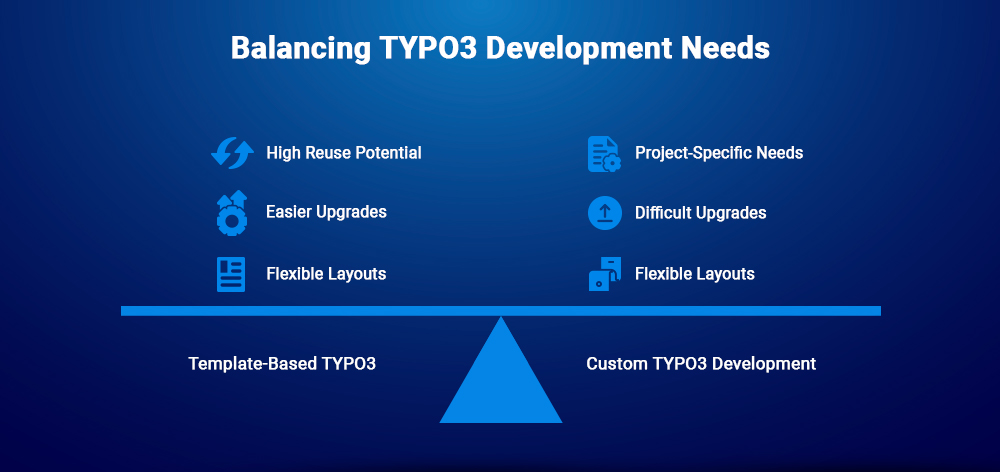
The question of template vs custom in TYPO3 is seldom purely a matter of technology. It shows the struggle of the needs for reusability, flexibility, and long-term responsibility for the system to be accommodated.
Usually, the teams working with TYPO3 have to deal with several projects that have much in common. Making use of the same layouts and patterns for different projects will save time, but then again, each project will always come with specific design or content needs this time around.
This puts the designers in a dilemma:
The lifespan of TYPO3 websites is planned in the long term. The process of each LTS upgrade involves the review of templates, extensions, and custom code.
In this sense:
What was offered as flexible at the start may eventually turn out to be expensive during the upgrading phase.
The editors can not wait for the development time while they want to make changes in the layouts and content. The developers need to have clear regulations, so the systems remain stable and upgrade-safe.
So under such circumstances:
The issue is about locating a middle ground where both roles will be supported without the emergence of long-term problems.
Custom TYPO3 development offers maximum control, but that control comes with trade-offs that only become visible over time.
Custom development is the best option when it's about projects that require:
In such cases, using templates would make the situation worse by imposing limitations instead of offering any efficiency.
Custom solutions generally begin as clean ones, but their complexity increases when there are changes in the requirements.
The most common problems are:
What is perceived as flexible at the beginning of the project can eventually lead to the slowdown of the teams as the project gets matured.
With every TYPO3 LTS upgrade, it is mandatory to go through the process of reviewing the custom templates and code.
As time goes by:
Custom development is still a very powerful tool, however, it demands a long-term commitment and discipline to remain manageable.
Templates can reduce effort and speed up delivery, but problems arise when they are used without clear boundaries or long-term planning.
Many templates try to include all the possible use cases.
This usually results in:
Overloaded templates do not simplify projects but rather increase the complexity of the work.
Templates usually either are too rigid or too loose in their use.
Editors facing common issues at the extremes:
Both situations delay the teams and contribute to unnecessary rework.
Certain templates combine the layout decision and project-specific logic.
This situation leads to problems if:
When no separation is made, templates cease to be reusable foundations.
T3Karma aims to solve common issues in template, based TYPO3 projects and at the same time it doesn't try to replace custom development. T3Karma's benefit is in standardization and reuse rather than trying to cover every single use case.
T3Karma comes with a set of layout and content patterns that are consistent and which can be reused for different projects.
It allows teams to:
Start projects on a solid and tested foundationStop redesigning the same page types over and overMake page layouts easy to understand for both editors and developersBy standardising, decision making overhead is reduced and long, term consistency is therefore improved.
Many TYPO3 projects end up with similar frontend and TypoScript logic.
T3Karma helps in these ways:
When page layouts behave consistently, editors are able to work more efficiently.
T3Karma contributes to this by:
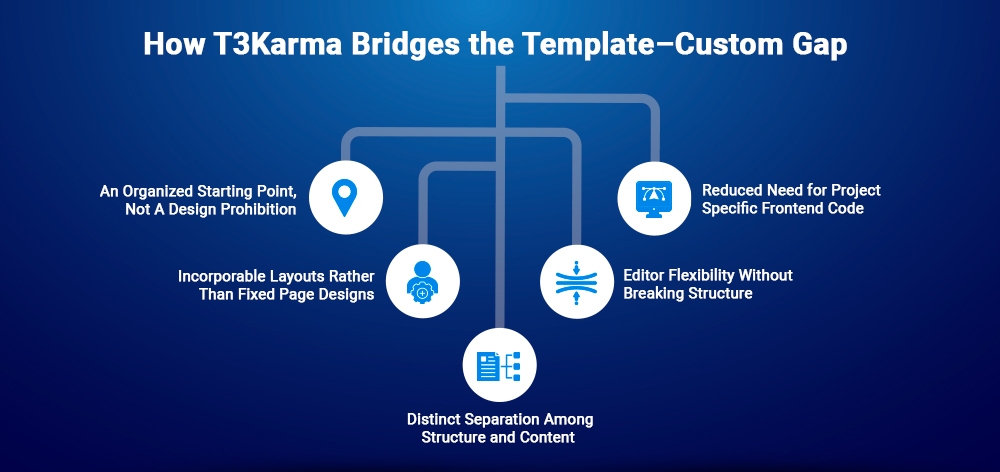
T3Karma is a product that sits between the rigid templates and a completely customized TYPO3 development in a way that it is the beginning point for the whole project while controlling the project-specific operations in the area that need it most.
T3Karma does not impose a single design of its own. Rather, it presents an organized base that the groups can modify.
The distinctive features are:
The whole thing enables the teams to not start over every time and at the same time gives the possibility of changes in the future.
T3Karma does not limit layouts to single pages, but instead offers patterns of reusable layouts for different uses.
This method:
T3Karma ensures that its main parts content, layout, and logic are separated from one another in such a way that each can work and be changed independently.
Thus:
This separation is a good thing for upgrade safety and long term maintenance.
The editors require flexibility but only within the limits defined.
This is supported by T3Karma:
A lot of TYPO3 projects have the same frontend logic repeated.
With T3Karma:
This keeps custom development focused on real project needs instead of repeated setup work.
TYPO3 projects are built to run for many years. How well they survive multiple LTS upgrades depends less on features and more on how much project-specific code accumulates over time.
Template-based projects tend to be easier to upgrade when the template structure is stable and well maintained.
In practice:
Problems arise when templates are heavily modified per project.
Every line of project-specific code increases long-term responsibility.
Over time:
Reducing duplication and relying on shared structures lowers both technical and organisational risk.
T3Karma is maintained with defined TYPO3 LTS targets and a clear separation between template structure and project extensions.
This helps teams:
The result is a more predictable upgrade path and lower maintenance effort over the lifetime of the project.
TYPO3 projects are planned to be running for a long time. Their survival through the multiple LTS upgrades is a matter of how much project-specific code has been developed over the years, not the features.
Templates are easier to upgrade in the case the template structure is guru and stable.
In real life:
Problems arise when every project modifies the templates too much.
Every line of project-specific code increases long-term responsibility.
Gradually:
Technical and organizational risk is lower when duplication is reduced and reliance on shared structures is increased.
T3Karma is kept in line with TYPO3 LTS targets that are set and the template structure and project extensions are clearly separated.
This not only helps the teams:
The outcome is a more predictable upgrade path and lesser maintenance effort over the total project lifespan.
The template vs custom decision in TYPO3 is about long-term complexity, not speed alone. Custom development offers flexibility but increases upgrade and maintenance effort over time. Templates reduce effort only when they are structured and used with clear limits.
T3Karma provides a stable starting point that supports reuse, predictable editor workflows, and TYPO3 LTS upgrades without blocking custom work.
If your projects repeat similar layout and content patterns, T3Karma is a practical foundation to evaluate before building everything from scratch.
Yes. T3Karma is designed for long-running TYPO3 projects that require predictable structure, controlled editor workflows, and regular LTS upgrades.
Yes. T3Karma provides a foundation. Project-specific logic and extensions can be added without modifying the template core.
It limits unstructured freedom, not design capability. Custom layouts and styling can be added where needed, while common patterns stay consistent.
It can reduce upgrade effort by limiting project-specific template code and relying on a maintained, LTS-aligned base.
Yes. Its structured layout and reusable components support consistent setups across multiple sites.
When the project requires a fully bespoke UX or heavy frontend logic that cannot be expressed through reusable patterns.



Anna Scholz
Extension Support SpecialistAnna knows TYPO3 extensions inside out. With hands-on experience supporting both core and custom solutions, she delivers answers that are not only correct but smart. Her priority: help users get the full power of TYPO3…
More From Author