
TYPO3 in the AI Era: How Intelligent Tools Enhance Enterprise CMS Workflows
AI


Maintaining a consistent brand voice across languages is a common challenge in TYPO3 translation projects. TYPO3 manages language overlays and structured content reliably, but it does not define how tone, terminology, or style should stay aligned between languages.
As multilingual websites grow, this gap becomes more visible. Editorial reviews take longer, wording differences accumulate, and small inconsistencies spread across pages. In DACH projects, formal language, legal wording, and long content lifecycles increase this effort further.
This guide explains how TYPO3 teams handle translation today, where core features reach their limits, and how AI-supported workflows fit into real projects.
It also shows how the AI Assistant for TYPO3 supports TYPO3 translation by helping teams scale multilingual content while keeping brand voice and long-term maintainability under control.
This guide focuses on real TYPO3 translation challenges that appear once websites grow beyond a single language or a small editorial team. It is written to support practical decisions, not to promote tools.
This guide will be applicable in the following scenarios.
This guide will not apply in the following cases.
TYPO3, though allowing for the effortless management of websites in different languages, does not impose consistency in brands automatically. The more the content and the people involved, the greater the disparity in tone and terminology across the languages.
The main concern of TYPO3 core is to provide a reliable structure rather than a language that is of high quality. XLIFF files and language overlays replicate the content precisely, but they do not take into consideration the rules of tone, style, or preferred wording.
This creates frequent problems:
Gradually, these differences cause the brand inconsistency that is especially hard to get rid of in DACH areas where legal or formal language is the case.
Most teams more or less raise the bar by the manual check and correction. This way, the quality remains high, but there will also be a persistent effort involved.
The usual time looses are:
What is intended as a translation task often turns into a repetitive maintenance activity instead of being a one-off effort.
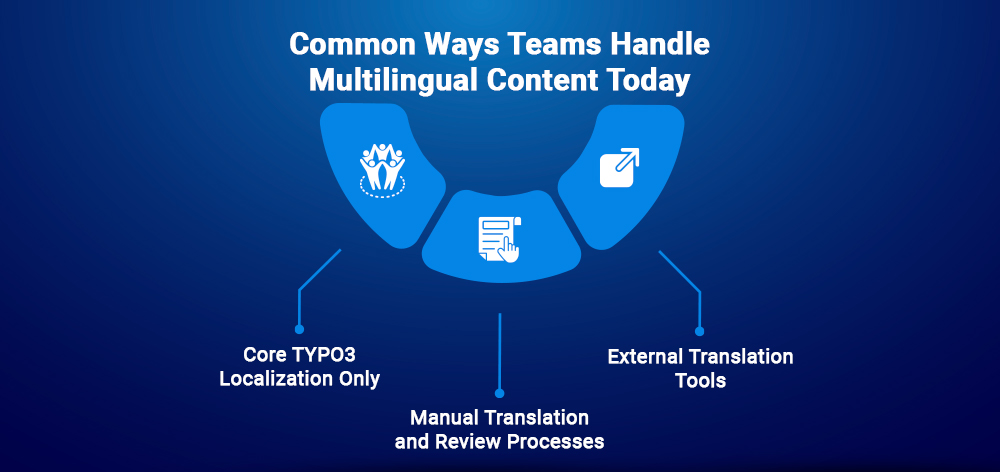
Usually, TYPO3 teams rely on a blend of manual processes, external tools, and core features to organize the whole translation issue. Every single one of them deals with some issue, but they all do it without the brand consistency that is the end goal.
The TYPO3 core localization is dependable and has been well integrated with the rest of the system. Language overrides and XLIFF handling are working without any problem from one version to the next.
With this method:
It is suited for very small teams with strict internal review processes.
A lot of teams depend on editors or translators to manually review and rewrite each language content.
With this method:
With every update or relaunch the review effort increases over time.
To speed up translation work, external tools are often employed.
With this method:
Lacking clear guidelines, these tools can create inconsistencies that need to be corrected afterwards.
AI technology can facilitate TYPO3 translation processes, however, it cannot take over the responsibility of the editor. The extent of its usefulness relies on the degree to which rules and review processes are explicitly stated.
AI is a good partner for repetitive and structured tasks.
Among the notable examples are:
In this manner, AI helps to lessen manual work while the editor's authority remains intact.
Editorial review is still necessary for content categorized as high-risk or sensitive.
The content areas that are usually classified as such include the following:
The whole procedure can end up being faster, but it is the editorial team whose power of decision remains in the areas of accuracy and tone.
For an agency, the goal is to move away from "per-page" translation and toward a Centralized Content Strategy. AI Assistant for TYPO3 is an enterprise-grade meta-extension for TYPO3 that acts as a secure bridge between your CMS and various Large Language Models (LLMs) like OpenAI, Azure, and Gemini.
It integrates AI directly into the TYPO3 backend, transforming it from a static repository into an intelligent content engine.
The primary weakness of generic AI is its unpredictability. AI Assistant for TYPO3 solves this through the AI Prompt Manager. Instead of editors entering manual instructions for every content element, the extension allows architects to define a "Global Brand Persona."
By pre-configuring these prompts, you ensure that every API call to the LLM carries the necessary constraints:
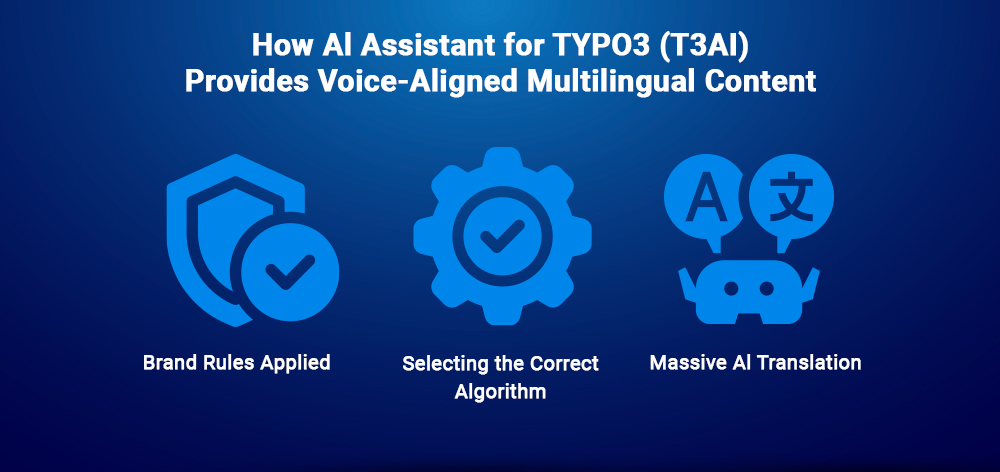
The agency's aim is to change its content localization strategy from "per-page" to a Centralized Content Strategy. T3AI, the AI Assistant for TYPO3, serves as a meta-technology that birdges your CMS securely with different LLMs like OpenAI, Azure, and Gemini among others.
It brings the AI directly into the TYPO3 back office, thereby changing it from a static archive into a dynamic content generator.
The main drawback of artificial intelligence in its generic form is the lack of reliability. The T3AI application however, manages to escape this predicament by utilizing the AI Prompt Manager.
Instead of the content editors providing manual instructions for each element of content in the extension, the system allows the creators to set up a "Global Brand Persona."
By setting up these prompts in advance, you can be sure that each API call to the LLM comes with the needed constraints:
The ranking of AI models is not the same overall.
A well-experienced developer knows that DeepL is perfect for the issue of raw linguistic correctness, while GPT-4o or Claude 3.5 Sonnet are the ones who are the best at the aspects of creative adaptation and subtlety depending on the context.
AI Assistant for TYPO3 lets you to choose between different models according to the specific task.
DeepL may be used for localization of technical XLIFF files where accuracy is essential, but switching to Gemini or ChatGPT for the marketing text may be the case where the 'Brand Voice' has to be more convincing and accommodating to the target culture.
Usually, the sites of large companies do not contain only five pages; they contain hundreds. It takes a lot of time and is not the best way to use peoples' skills performing clicking on every record to translate manually.
AI Assistant for TYPO3 offers Mass Translation and Page Tree Generation features.
You can:
By taking out these non-value tasks, AI Assistant for TYPO3 helps in getting the "Time-to-Market" for a new language rollout down by as much as 60%. Centralized prompts, however, make sure the output stays within the boundaries of your defined brand guardrails.
One of the most significant friction points in traditional TYPO3 localization is the "Data Silo" effect.
Typically, content is exported to external tools, translated, and then re-imported. This loop is where technical errors, such as broken links, lost metadata, or corrupted XLIFF structures, frequently occur.
TYPO3's AI Assistant does not need any external middleware as it brings the genius of the solution straight to the data.
.xlf files right in the backend.This "In-CMS" workflow makes sure that the Brand Voice is applied not only to the body copy but also to every technical string consistently.
"SEO Fragmentation" is the most frequent outcome that occurs in multilingual projects. The technical SEO parts Slugs, Meta Titles, and Descriptions are mostly neglected or not done very well, even though the main content is translated.
AI Assistant for TYPO3 takes care of these elements automatically:
AI Assistant for TYPO3 has made it easy for the brand's technical footprint to be as refined and sophisticated as its main marketing copy with no need for the developer to manually handle thousands of SEO fields.
In professional TYPO3 setups, AI support must be governed by strict rules. The flexibility that AI provides to the editorial department is acceptable only when the rules of who is responsible for what, the limits of the reviewer, and the process of review are clearly defined from the very start.
AI Assistant for TYPO3 has been created to support this equilibrium by fusing AI into the current TYPO3 workflows without the backend getting uncontrolled behavior.
AI Assistant for TYPO3 installs AI tools right in the TYPO3 backend where editors are already working, such as the Rich Text Editor and page management views. Editors can use AI to support daily tasks, but always within boundaries defined by the technical team.
Key characteristics:
This guarantees that AI is not bypassing review or governance but is still assisting editorial work.
The technical teams will always be the ones responsible for configuration, access, and operational stability.
This encompasses:
AI Assistant for TYPO3 is also keeping transparent usage logs, which allows the administrators to monitor activity, analyze usage patterns, and maintain AI-supported workflows that are predictable and auditable.
One of the principal strategic decisions for agencies and large companies is to determine the areas where the AI Assistant for TYPO3 extension can be used and where the traditional methods will still be employed.
The aim is not to eliminate human workers but rather to free the team to work on higher-value tasks by the assistant.
AI Assistant for TYPO3 is always a "victory" when you face loads of repetitive tasks regarding content or technical data.
AI has constraints. In such cases, the human effort or standard TYPO3 core features are still the best solution.
Keeping a brand's voice in different languages in TYPO3 is not mainly a translation issue. It is a matter of governance and process control.
The TYPO3 core offers a solid foundation for multilingual content, yet the uniformity of style and words relies on the planning and enforcement of translation procedures over time.
Workflows aided by AI can help in lowering the manual effort and rising the consistency provided that they operate within the clearly defined limits.
The AI Assistant for TYPO3 provides an organized manner for backend support of translation and rewriting without altering the primary processes or risking the long-term maintainability for TYPO3 teams that are dealing with multilingual content at large scale.
Teams use the AI Assistant for TYPO3 Prompt Manager to pre-define "Brand Personas" and rules that the AI must follow for every translation, ensuring a uniform tone regardless of the target language.
No, it replaces the mechanical task of first-drafting, allowing professional translators to move into a high-value "Editor-in-Chief" role focused on final nuance and quality assurance.
Yes, because AI Assistant for TYPO3 allows you to route data through secure, GDPR-compliant endpoints like Azure OpenAI (EU) or local Ollama instances, keeping sensitive data protected.
TYPO3 core provides the empty database structure and record links, while AI Assistant for TYPO3 provides the "intelligence" to instantly fill those records with context-aware, brand-aligned content.
Yes, because developers use AI Assistant for TYPO3’s backend settings to restrict editors to pre-approved "Prompt Templates" and specific AI models, maintaining total architectural control.


Jürgen Pietschmann
TYPO3 AI ConsultantJürgen is a TYPO3 AI Consultant at AI Universe. He helps businesses make the most of their TYPO3 websites by integrating AI-powered solutions. From smart content creation and automated SEO improvements to seamless chatbot…
More From Author