

EU AI Act for TYPO3: What Site Owners and Agencies Must Do Now
AI


Ask an editorial team about AI content labelling in TYPO3 and the conversation lands on the writing. That is the wrong moment. The problem shows up months later, when a page is reviewed and nobody can say any more which paragraph an AI produced.
Article 50 of the EU AI Act has applied since 2 August 2026. It asks for two things. People must be told when they are dealing with an AI, and certain AI-generated content has to be recognisable as such.
This post covers which content is caught and which is expressly not. It also covers how to express that in TYPO3 without your editors labelling everything as a precaution. The wider frame, meaning roles, deadlines and penalties, is in our post on the EU AI Act for TYPO3, which we are glad to work through with you.
The short answer: Article 50 spreads four duties across two roles. Providers must design interactive systems so that people know they are talking to an AI. Providers must also mark generated output in a machine-readable way. Deployers, which is you as the site operator, must disclose three things: the use of emotion recognition or biometric categorisation, deepfakes, and AI-generated text on matters of public interest published without human review.
The information has to arrive at the first interaction at the latest, clearly and distinguishably, and it has to meet the applicable accessibility requirements. Which of these duties reaches your organisation is something we are happy to sort out with you.
| Duty | Role | What it means for a TYPO3 site |
| Article 50(1), notice of AI interaction | Provider designs it, deployer must not defeat it | A chatbot says at first contact that it is an AI |
| Article 50(2), machine-readable marking | Provider of the generative system | Sits with the maker of the model or system, not with your editors |
| Article 50(3), emotion recognition and biometric categorisation | Deployer | Only reaches a site that runs such systems, and then without exception |
| Article 50(4), deepfakes and unreviewed public-interest text | Deployer | This is the duty your editorial team meets every day |
The last row is the one that shapes editorial work. And it has an exemption.
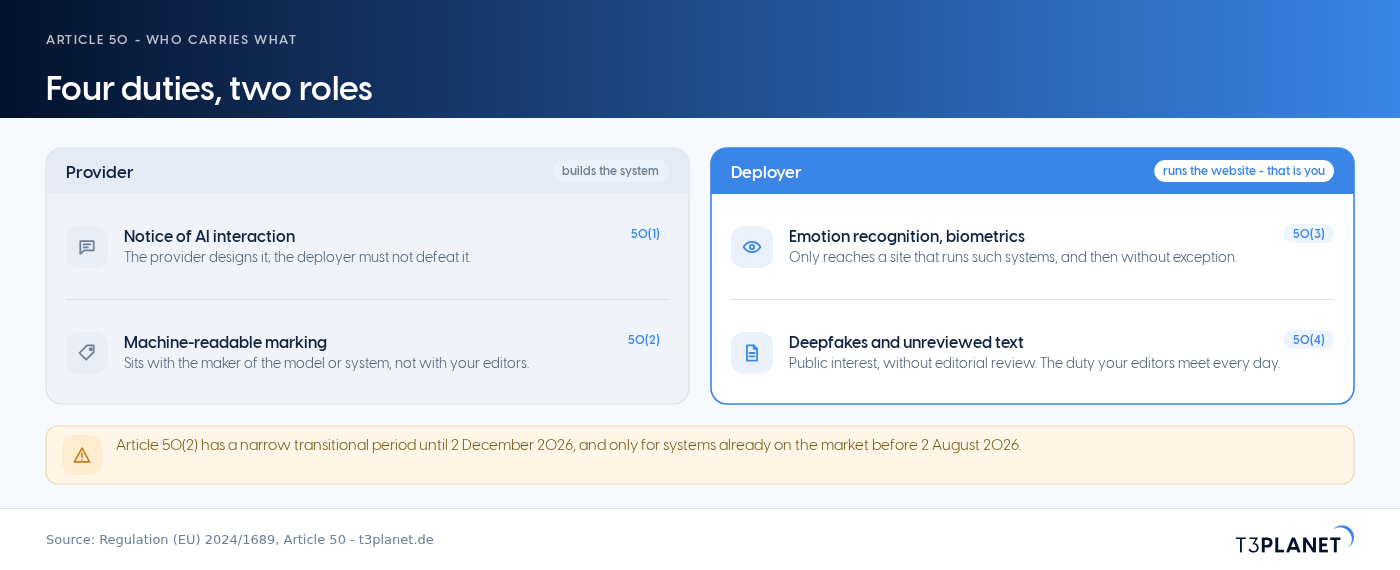
Figure: four duties, two roles, and the one row your editors meet every day.
The Commission puts it plainly in its own Q&A on Article 50: published text that has undergone human review or editorial control does not need to be labelled. Editorial control means a responsible entity that can approve, alter or reject the substance of the text.
That is not a technicality. It is a load-bearing sentence for a company editorial team. Three cases follow from it, and we are glad to go through them together with you:
The last point sounds obvious and still gets missed. Labelling everything an AI has touched makes a statement about your newsroom that is not true. Over-labelling is a claim, exactly as under-labelling is.
Label what the regulation asks for, not everything an AI has touched. An unnecessary label is a statement about your editorial process that you did not mean to make.
The usual approach is a field in the backend where somebody records whether a piece of content came from an AI. It works on day one and not afterwards, for three reasons.
The information you need exists in complete form at exactly one moment: generation. That is where AI Foundation for TYPO3, the open-source foundation T3Planet maintains, starts, alongside the AI extensions that build on it. We are glad to look at that point together with you, on your own content.
AI Label has been part of AI Foundation for TYPO3 since ns_t3af 1.2.0 of 26 August 2026, and available in the AI Assistant since ns_t3ai 14.3.0 of 25 August 2026. The flow has four steps, and we set it up together with your editorial team.
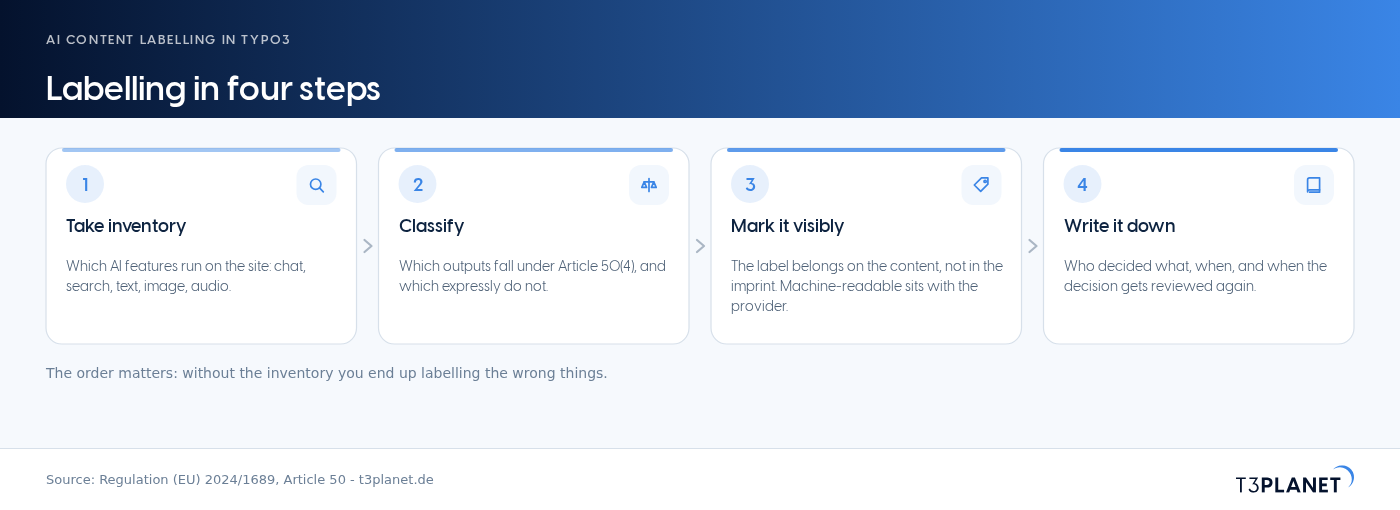
Figure: the order matters. Without the origin record, the later steps have nothing to work from.
If you would rather see it than read about it, this is AI Foundation in the TYPO3 backend, as an interactive walkthrough. It is the same showcase we keep on the AI Foundation for TYPO3 page.
AI Foundation is where every AI feature meets. That makes it the only place a complete origin record can form. The extensions report what they generate to that one place through a shared interface. Which of them are running on your site is something we are glad to look at with you, and the whole family is described on the AI Universe for TYPO3 page.
| Extension | What it generates | Relevant to labelling |
| AI Foundation (T3AF) | generates nothing itself, brings it together | module, rules, badge, evidence |
| AI Assistant (T3AI) | text, images, page structures, SEO fields, translations | generated and translated content |
| AI Accessibility (T3AA) | alt text, file metadata, audio and voiceover | synthetic audio is named explicitly in Article 50(2); an AI alt text does not make the image AI-generated |
| AI Chatbot (T3AC) | answers in conversation with visitors | the AI interaction notice, in the widget itself |
| AI Search (T3AS) | AI answers over your content | the same notice, at the search |
The row that produces the most labelled content is usually the AI Assistant, and how a team actually works with it is walked through in our post on moving from manual writing to AI-driven content.
Chatbot and Search produce their answers at the moment of the request and do not store them as content. Their duty is therefore a different one: the notice at first contact, right where the conversation happens. Both extensions have carried it since version 14.2.4. AI Label handles what is stored in your system.
This section is written for the colleague who has to answer the question at the end, not for the editors. They are not on their own with it: we supply the evidence they can put on the table.
Article 50 sets out no documentation duty of its own. Evidence still decides the outcome, because the exemption for editorially reviewed text hangs on exactly that: a named responsible person and a traceable review step. Without something to show, the exemption is hard to rely on.
The module in AI Foundation therefore brings Overview, Media, Texts and Settings into one place and allows an export of the evidence. We set that export up with you, so the answer is ready before the question arrives. The export is a filtered view of what was logged anyway, with reason codes attached to decisions. It lets you show what was generated, who confirmed it, and why a piece of content was labelled or was not.
One point we would rather make before the fact than after: AI Foundation is compliance-ready tooling, not a compliance guarantee. Which of your content counts as a matter of public interest is a legal judgement your organisation makes, not one a piece of software makes for you.
No. The duty covers text on matters of public interest published without human review or editorial control. Text that has been reviewed, with a named person holding responsibility, is not caught.
For deployers, the disclosure duty bites on deepfakes, meaning image, audio or video content depicting real people or events. There is no general deployer-side labelling duty for other generated images.
No. The Commission provides three icons in four variants each and states that their use is optional while the Article 50 labelling requirements are not. We ship them unmodified, because a recognisable label works better than an invented one.
Nothing. AI Foundation for TYPO3 is open source under GPL-2.0-or-later, free, with no licence key and no registration, on any domain. The AI extensions that build on it are licensed.
Yes. Labelling needs no active model provider. You can install AI Foundation for this purpose alone.
TYPO3 v12 to v14 with PHP 8.2 or newer.
If your question is not here, we are glad to work through it together with you.
Jürgen Pietschmann
TYPO3 Consultant at T3PlanetJürgen Pietschmann is a T3Planet Product Consultant at T3Planet Shop and Head of Technology at keeen GmbH. He specialises in integrating AI into editorial workflows – from intelligent content creation and automated SEO to…
More From Author