


Why Your Business Needs SLAs: Benefits and Advantages Explained
Maintenance


Looking to enhance your TYPO3 website's functionality and aesthetics? Discover 11 ways to add CSS/JS frontend assets with this comprehensive guide.

Are you looking for reliable ways to add CSS and JavaScript assets in TYPO3?
As a TYPO3 integrator, developer, or administrator, you’ll often need to include custom stylesheets or third-party JavaScript libraries into a TYPO3 instance, whether for templates, extensions, or specific pages.
In this blog, you’ll learn all 11 proven methods to add internal and external CSS/JS assets into TYPO3, clearly explained and ready to apply in real projects.
TYPO3 is a flexible and extensible open-source CMS, designed to handle a wide range of frontend requirements. Depending on the use case, legacy systems, modern templates, or extension development, TYPO3 provides multiple ways to integrate frontend assets cleanly and predictably for efficient TYPO3 development.
That flexibility also makes it possible to introduce new development capabilities through solutions such as the AI Foundation for TYPO3, while keeping AI providers, permissions, and workflows centrally managed.
Let’s walk through each method and understand where it fits best.
TYPO3 offers multiple ways to include CSS and JavaScript, but not every method fits every use case. The right approach depends on your role, your TYPO3 version, and whether you’re working on a template, page, or extension.
Use the guidance below to quickly identify the most suitable method before diving into the full list.
<f:asset.css />, <f:asset.script />) - Best for template-based asset inclusion in modern TYPO3 versionsGoal: clean structure, predictable rendering, future-safe upgrades
additionalHeaderData / additionalFooterData in new extensionsGoal: encapsulated assets, upgrade-safe extensions, no global side effects
includeJS, includeCSS, HeaderData) may still be validGoal: stability first, modernization step by step
The sections below explain all 11 methods in detail, including when and how each one is used.
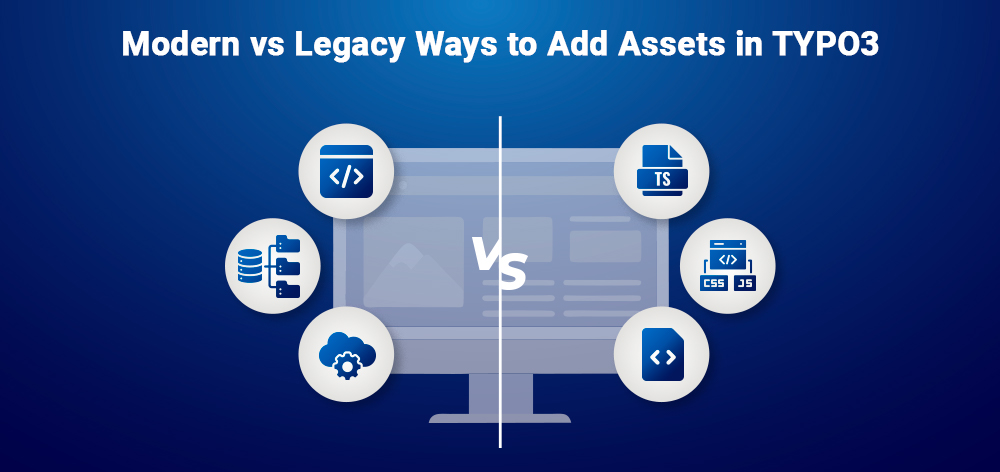
TYPO3 provides multiple ways to include CSS and JavaScript, but not all approaches carry the same weight today. Some methods are modern and recommended, while others exist primarily for backward compatibility.
The classification below helps you understand which approaches TYPO3 encourages today and which ones should be used only when maintaining older projects.
These methods align with current TYPO3 architecture and are suitable for new projects and ongoing development:
<f:asset.css />, <f:asset.script />)These methods are still supported but are generally intended for older TYPO3 projects or specific edge cases:
includeJS, includeCSS, HeaderData, FooterData)additionalHeaderData / additionalFooterData in Extbase controllersThe detailed sections below explain all 11 methods, including when legacy approaches may still be necessary.
From TYPO3 v10 onwards, Fluid Asset ViewHelpers provide a clean and structured way to include CSS and JavaScript in TYPO3 templates.
Using <f:asset.css /> and <f:asset.script />, assets can be registered directly within Fluid templates while maintaining predictable rendering and better control.
This approach is well-suited for modern TYPO3 projects where assets are tightly coupled with template logic and should follow TYPO3’s recommended frontend architecture.
<f:asset.css identifier="yourIdentifier" href="EXT:yourext/Resources/Public/Css/myCustom.css" /><f:asset.css identifier="yourIdentifier">.myBlock { display: block }</f:asset.css><f:asset.script identifier="yourIdentifier" src="EXT:yourext/Resources/Public/Css/myCustom.js" /><f:asset.script identifier="yourIdentifier">alert('hello world');</f:asset.script>
Reference: View Document
Since TYPO3 v8, Fluid HeaderAssets and FooterAssets allow you to define frontend assets directly inside Fluid templates using dedicated sections.
This method is useful when assets need to be injected explicitly into the <head> or at the end of the <body>.
While still supported, this approach is more commonly found in older TYPO3 setups and is often replaced by AssetCollector or Fluid Asset ViewHelpers in newer projects.
<f:section name="HeaderAssets"><!-- Write down anything which you want to add into <head> tag --></f:section><f:section name="FooterAssets"><!-- Write down anything which you want to add into </body> tag --><script async src="//yourdomain.com/your.js"></script></f:section>
Reference: View Document
HeaderData is one of the traditional TypoScript-based methods to inject CSS or JavaScript into the <head> section of a TYPO3 page.
It allows assets to be added globally or conditionally based on page IDs.
This method is primarily used in legacy TYPO3 projects and should be avoided in new implementations unless backward compatibility is required.
page.HeaderData.99 = TEXTpage.HeaderData.99.value = <script async src="//yourdomain.com/your.js"></script>
FooterData works similarly to HeaderData, but outputs assets just before the closing </body> tag.
This is often preferred for JavaScript files to reduce render-blocking and improve perceived performance.
Like HeaderData, this approach is mainly relevant for older TYPO3 installations.
page.FooterData.99 = TEXTpage.FooterData.99.value = <script async src="//yourdomain.com/your.js"></script>
includeJS is one of the most widely used TypoScript methods for adding JavaScript files to TYPO3 templates.
It supports loading scripts in the header, footer, or as libraries, depending on configuration.
Although still supported, this method is considered legacy in modern TYPO3 projects and should be used cautiously alongside newer asset-handling mechanisms.
page.includeJS {yourIdentifier = EXT:yourext/Resources/Public/Css/myCustom.js}
Tips:
You can use config.moveJsFromHeaderToFooter to shift scripts for better performance.
If you need to include inline JavaScript, TYPO3 provides jsInline and jsFooterInline. This allows you to write JavaScript code directly without referencing an external file.
Inline scripts should be used sparingly, as they are harder to cache and maintain compared to file-based assets.
page.jsInline {// Your JavaScript code}
includeCSS allows you to register CSS files via TypoScript and include them in the <head> section. This method is commonly found in older TYPO3 templates and legacy integrations.
For modern projects, Fluid Asset ViewHelpers or AssetCollector are generally preferred.
page.includeCSS {yourIdentifier = EXT:yourext/Resources/Public/Css/myCustom.css}
cssInline enables you to define inline CSS directly through TypoScript.
This can be useful for small, dynamic styles but should not replace structured, file-based CSS in larger projects.
page.cssInline {10 = TEXT10.value = h1 {margin:15px;}}
For extension developers working with Extbase, additionalFooterData allows JavaScript to be injected dynamically from a controller.
This method provides flexibility but bypasses modern asset management workflows.
It is generally considered legacy for new extension development.
$GLOBALS['TSFE']->additionalFooterData['yourIdentifier'] ='<script async src="//yourdomain.com/your.js"></script>';
Similar to additionalFooterData, this method injects assets into the <head> section from an Extbase controller.
While still functional, it is not recommended for modern TYPO3 extensions.
$GLOBALS['TSFE']->additionalHeaderData['yourIdentifier'] ='<script async src="//yourdomain.com/your.js"></script>';
From TYPO3 v10 onwards, AssetCollector is the recommended way to manage CSS and JavaScript in Extbase extensions.
It provides centralized asset handling, priority control, and avoids duplication across templates and extensions.
This is the preferred approach for modern TYPO3 development.
GeneralUtility::makeInstance(AssetCollector::class)

  ->addJavaScript(

      'yourIdentifier',

      'EXT:yourext/Resources/Public/Css/myCustom.js',

      ['data-foo' => 'bar']

  );
AssetCollector offers a rich API for managing assets throughout the request lifecycle and should be the default choice for new extensions.
AssetCollector::addInlineJavaScript()

AssetCollector::addStyleSheet()

AssetCollector::addInlineStyleSheet()

AssetCollector::addMedia()

AssetCollector::removeJavaScript()

AssetCollector::removeInlineJavaScript()

AssetCollector::removeStyleSheet()

AssetCollector::removeInlineStyleSheet()

AssetCollector::removeMedia()

AssetCollector::getJavaScripts()

AssetCollector::getInlineJavaScripts()

AssetCollector::getStyleSheets()

AssetCollector::getInlineStyleSheetsAssetCollector::getMedia()
Reference: View Document
TYPO3 supports multiple ways to include CSS and JavaScript, but the recommended approach changes by TYPO3 version. The overview below summarizes which methods are preferred and which should be treated as legacy.
This section is a quick reference and does not replace the detailed explanations that follow.
Recommended
<f:asset.css />, <f:asset.script />)Why this matters
Legacy / Avoid for new projects
HeaderData / FooterDataadditionalHeaderData / additionalFooterDataRecommended
Acceptable (legacy but supported)
includeJS / includeCSSCommonly used
includeJS / includeCSS(jsInline, cssInline)Consider
Legacy only
HeaderData / FooterDataNote
The sections below explain all 11 methods in detail, including their use cases and limitations.
Last but not least, with the above so many ways - You may have questions about the exact render order or priority of assets in TYPO3.
From v10.3, CSS and JavaScript registered with the AssetCollector will be rendered after their PageRenderer counterparts. The order is
<head>page.includeJSLibs.forceOnToppage.includeJSLibspage.includeJS.forceOnToppage.includeJSAssetCollector::addJavaScript() with ‘priority’page.jsInlineAssetCollector::addInlineJavaScript() with ‘priority’</head>page.includeJSFooterlibs.forceOnToppage.includeJSFooterlibspage.includeJSFooter.forceOnToppage.includeJSFooterAssetCollector::addJavaScript()page.jsFooterInlineAssetCollector::addInlineJavaScript()
How CSS and JavaScript are added in TYPO3 does not only affect functionality, it also impacts page performance, rendering behavior, and Core Web Vitals.
Understanding these implications helps you avoid common performance bottlenecks, especially in modern TYPO3 projects.
<head> to prevent layout shifts<head> can block rendering if not handled carefullyTYPO3 provides multiple ways to control where and when assets are rendered. Choosing the right method is key for performance-sensitive pages.
Modern approaches such as AssetCollector help avoid these issues by managing priorities and render order more predictably.
For TYPO3 v10 and above, AssetCollector is generally the safest choice for performance-aware projects.
These practices help keep TYPO3 projects fast, maintainable, and TYPO3 upgrade-friendly.
Even though TYPO3 offers multiple ways to include frontend assets, misusing them can lead to performance issues, unpredictable behavior, or upgrade problems. Avoid the common mistakes below to keep your TYPO3 project clean and maintainable.
What goes wrong
HeaderData, FooterData, or old includeJS patterns are used in TYPO3 v10+Why it’s a problem
What to do instead
What goes wrong
Why it’s a problem
What to do instead
What goes wrong
Why it’s a problem
What to do instead
What goes wrong
Why it’s a problem
What to do instead
What goes wrong
Why it’s a problem
What to do instead
What goes wrong
Why it’s a problem
What to do instead
Thanks for reading this guide. We hope it helped you clearly understand the different ways to add CSS and JavaScript assets in TYPO3, and when to use each approach in real projects.
TYPO3 offers multiple valid methods for asset integration, and the right choice always depends on your use case, TYPO3 version, and project structure. If you’ve worked with any of these methods before, feel free to share your experience in the comments.
If you’re curious about how AI is being applied in the ecosystem, take a look at the AI Universe for TYPO3, where practical TYPO3 workflows meet intelligent automation.
And for teams looking to streamline content creation, code generation, and optimization directly inside TYPO3, the T3AI - AI assistant provides a focused, all-in-one solution.
Build clean, maintainable TYPO3 projects with the right asset strategy and improved TYPO3 accessibility.
For TYPO3 v10 and above, Fluid Asset ViewHelpers and AssetCollector are the recommended approaches. They provide better control, predictable rendering, and are upgrade-safe.
includeJS and includeCSS are still supported, but they are considered legacy methods. They should mainly be used when maintaining older TYPO3 projects.
AssetCollector is used to register and manage CSS and JavaScript centrally, especially in Extbase extensions. It helps avoid duplication and improves render order control.
It’s technically possible, but not recommended. Mixing TypoScript, Fluid, and PHP-based asset inclusion can lead to unpredictable behavior and debugging issues.
Whenever possible, JavaScript should be loaded in the footer to reduce render-blocking and improve performance. TYPO3 provides multiple ways to control this.
For upgrades, keep existing methods stable first, then gradually migrate to AssetCollector or Fluid Asset ViewHelpers to align with modern TYPO3 best practices.


Markus Neumann
Template Support ManagerMarkus lives and breathes TYPO3 templates. Known for his structured thinking and eye for detail, he has helped hundreds of customers build faster, cleaner TYPO3 websites through T3Planet Shop. If there’s a template issue, Markus has probably solved it before.
More From Author